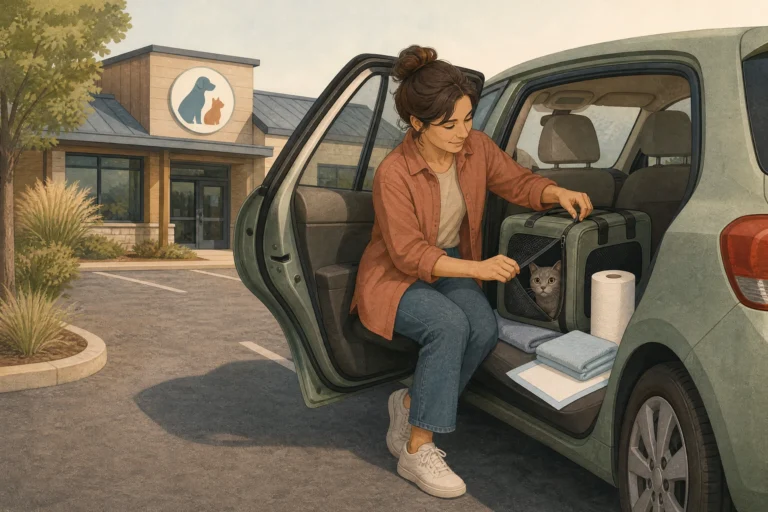
A cat panting in the car is a signal to act, not something to drive through. Unlike a dog, a cat does not normally cool itself by panting, and the veterinary sources list it only as a warning sign: Cornell’s Feline Health Center puts “excessive panting” among the signs of heat stroke, and its page on breathing difficulty lists noisy open-mouth panting as a sign of a cat that is struggling to breathe.
So when it starts: make the car cooler right away, pull over somewhere safe, and look at your cat. If the panting stops quickly once the cat is cool and still, and nothing else is wrong, it was most likely fear and a warm box, and the fix is how you do the next trip. If it keeps going, or comes with drooling, vomiting, weakness, a lowered head or a stretched-out neck, call a veterinarian now and drive there. Cornell’s rule is blunt: “Any time there’s a question about an animal’s ability to breathe comfortably, get it to a veterinarian right away.”
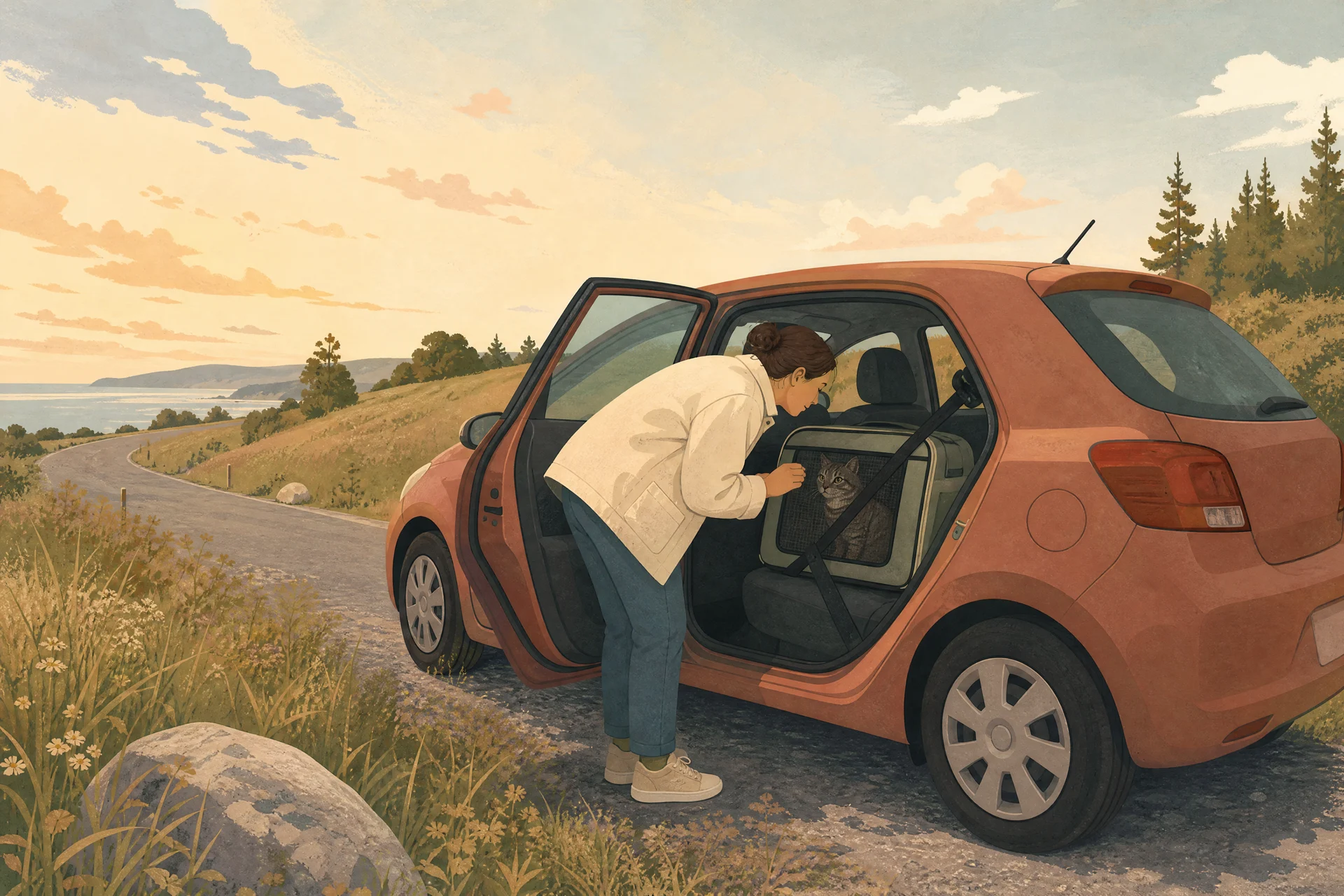
Why a panting cat is different from a panting dog
Dogs pant all the time — after a walk, in the sun, when they are excited — because panting is their main way to shed heat. Cats are built differently, and that is why owners who grew up with dogs underreact. On Cornell’s heat-safety page for cats, panting does not appear as a normal cooling behaviour at all. It appears in a list of warning signs next to weakness, drooling, vomiting and diarrhoea, with the instruction that heat stroke “can become life-threatening very quickly.”
That does not mean every panting cat in a carrier is in danger. Many cats pant briefly on the way to the vet and stop once the car is quiet and cool. The honest version is this: nobody can reliably tell harmless fear-panting from the start of heat stroke or a breathing problem by glancing in the rear-view mirror, and the cost of guessing wrong is very high for a cat. So you treat it as a reason to stop and check, every time, and you let what happens in the next few minutes tell you which situation you are in.
If you already read our note on bubble-window versus mesh cat backpacks, this is the car version of the same warning: an enclosed carrier in a warm space is where panting cats come from.
The three things it usually is, and how they look
In a car, panting usually comes from one of three places. They overlap — a frightened cat in a hot carrier is having two of them at once — but each has its own companions.
| What you see | What it may point to | What to do |
|---|---|---|
| Panting in a warm car, a carrier in the sun, or after the car sat parked; hot to the touch; drooling or vomiting | Heat. Cornell lists weakness or collapse, excessive panting, drooling, vomiting and diarrhoea as heat-stroke signs | Cool area with moving air, wet the fur with cool (not very cold) water, call a vet immediately. Do not dunk the cat in cold water |
| Started once the car moved; drooling, yowling, restlessness, maybe vomiting; the car is not hot | Fear and motion sickness. Merck lists excessive salivation, vomiting and signs of “uneasiness or apprehension” | Stop, cool, let the cat settle. If it clears fully, finish the trip gently and talk to your vet before the next one |
| Noisy, open-mouth breathing that does not settle; head low, body stretched forward; coughing or gagging | A breathing problem. These are the dyspnoea signs on Cornell’s list, whatever set them off | Call ahead and go to the nearest vet now. Do not wait to see if it passes |
| Weakness, collapse, unresponsive | An emergency, whatever the cause | Nearest emergency vet, calling on the way |
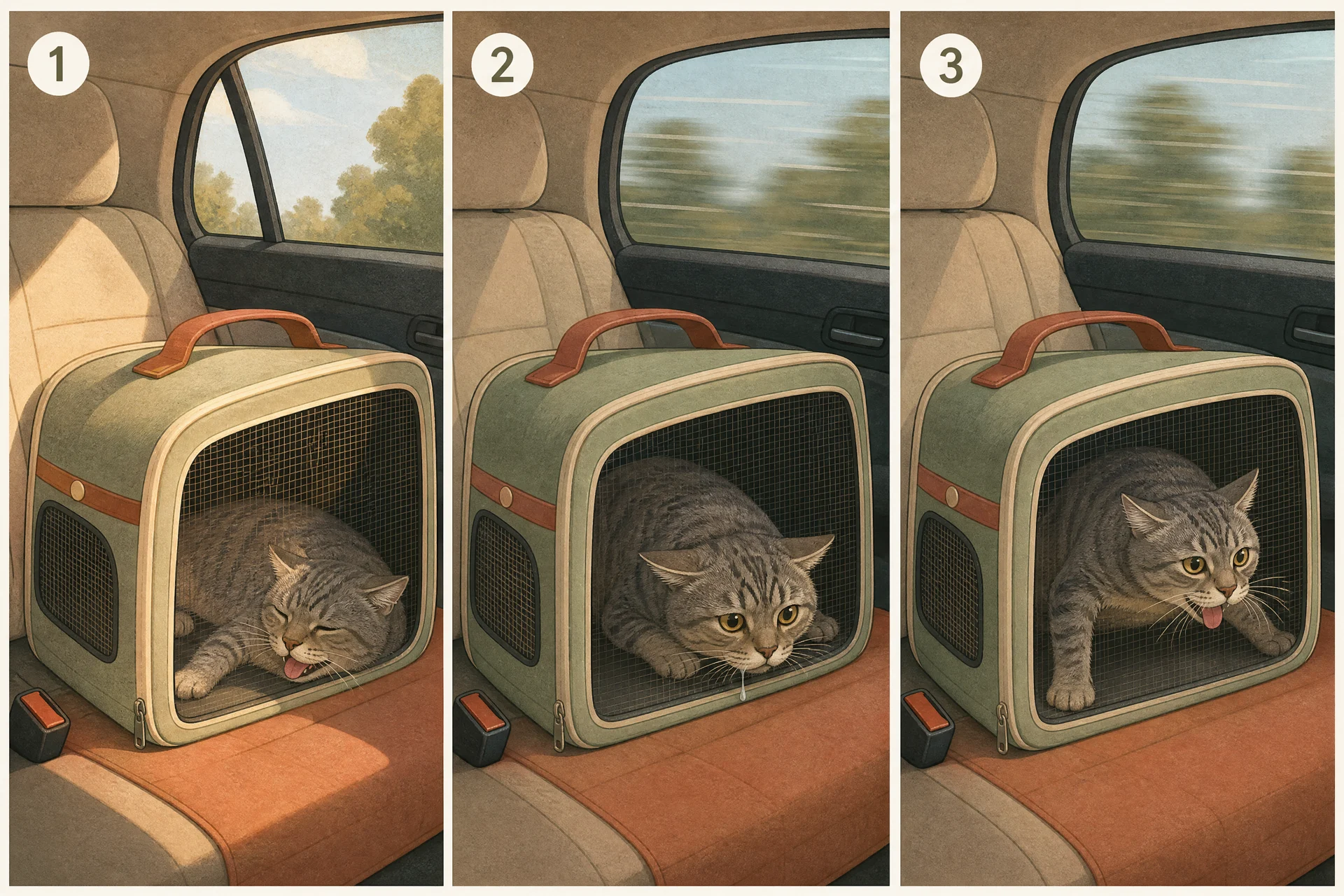
Heat is the one people underestimate, because the cabin feels fine to the driver. The carrier is not the cabin. A soft carrier with little mesh, sitting in a sunny side window with the air-conditioning vents pointed at the front seats, can be noticeably warmer inside than the air around your head — and the cat inside is wearing a fur coat and is frightened, which raises body heat on its own. The Merck Veterinary Manual’s emergency guidance calls heat stroke “an emergency,” lists “rapid panting” and “distress” among its signs, and warns that some breeds, “especially short-nosed breeds, can overheat from stress or excitement even on cool days” — worth knowing if you travel with a Persian or another flat-faced cat.
Fear and motion sickness are a frequent reason a cat pants on the way to the vet. The Merck Veterinary Manual’s page on motion sickness in cats describes nausea, excessive salivation, vomiting and apprehension, and adds a detail that explains a lot of cat car trips: “Fear of the vehicle may be a contributing factor in cats, and signs may occur even in a vehicle that is not moving.” A cat that starts panting in the driveway is not reacting to the motion. It is reacting to the car.
A breathing problem is the one you most need to catch. Cornell’s breathing-difficulty page notes that cats with dyspnoea “may pant noisily with an open mouth,” may cough, and often hold the head low with the body extended forward, and that any cat with breathing difficulty “is at high risk of dying if the respiratory problem is not treated promptly.” A stressful car ride can bring an underlying heart or airway problem to the surface. If your cat’s breathing looks like the third row of the table, this is not a travel problem any more.
What to do in the next five minutes
- Cool the cabin first, while you are still driving. Air-conditioning on, vents toward the back, sun off the carrier if you can shade it.
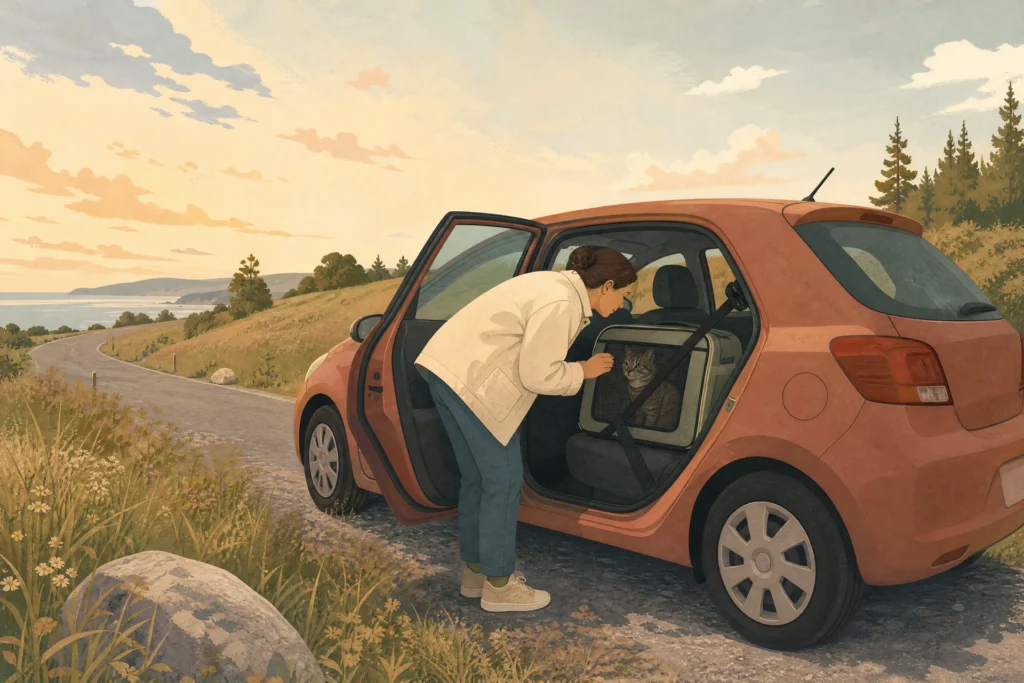
- Pull over somewhere safe. Not the hard shoulder of a fast road if you can reach an exit or a car park.
- Look without opening the carrier fully. A frightened cat that bolts from an open door at a roadside is a second emergency. Check through the mesh or with the top flap barely open: is the mouth still open, is there drool or vomit, is the cat alert or limp, does the carrier feel hot inside?
- Give it a few minutes of quiet, cool stillness. Engine running for the air-conditioning, no music, no handling.
- Decide. If the panting has stopped and the cat looks alert and otherwise normal, continue gently and keep the cabin cool. If it has not stopped, or anything else on the table is present, call the nearest vet, tell them what you are seeing, and go. Merck notes that calling ahead helps the clinic prepare for your arrival.
- If it looks like heat: follow Cornell’s instruction — a cool place with a draft, gently wet the fur with cool, not very cold, water, and contact your vet immediately. Merck adds: do not immerse the animal in cold water, and offer small amounts of water only once its temperature begins to come down.
If you were already driving to the vet, keep going and call from the car so the team knows to see your cat as soon as you arrive. A cat that has settled by the time you park is still worth mentioning at the appointment.
Setting up the car so it is less likely to happen
Most panting episodes are built before the engine starts: a warm car, a carrier in the sun, a cat who has never been in a car except to go to the vet. The carrier setup that keeps a cat safe in a crash is also the setup that keeps it cooler.
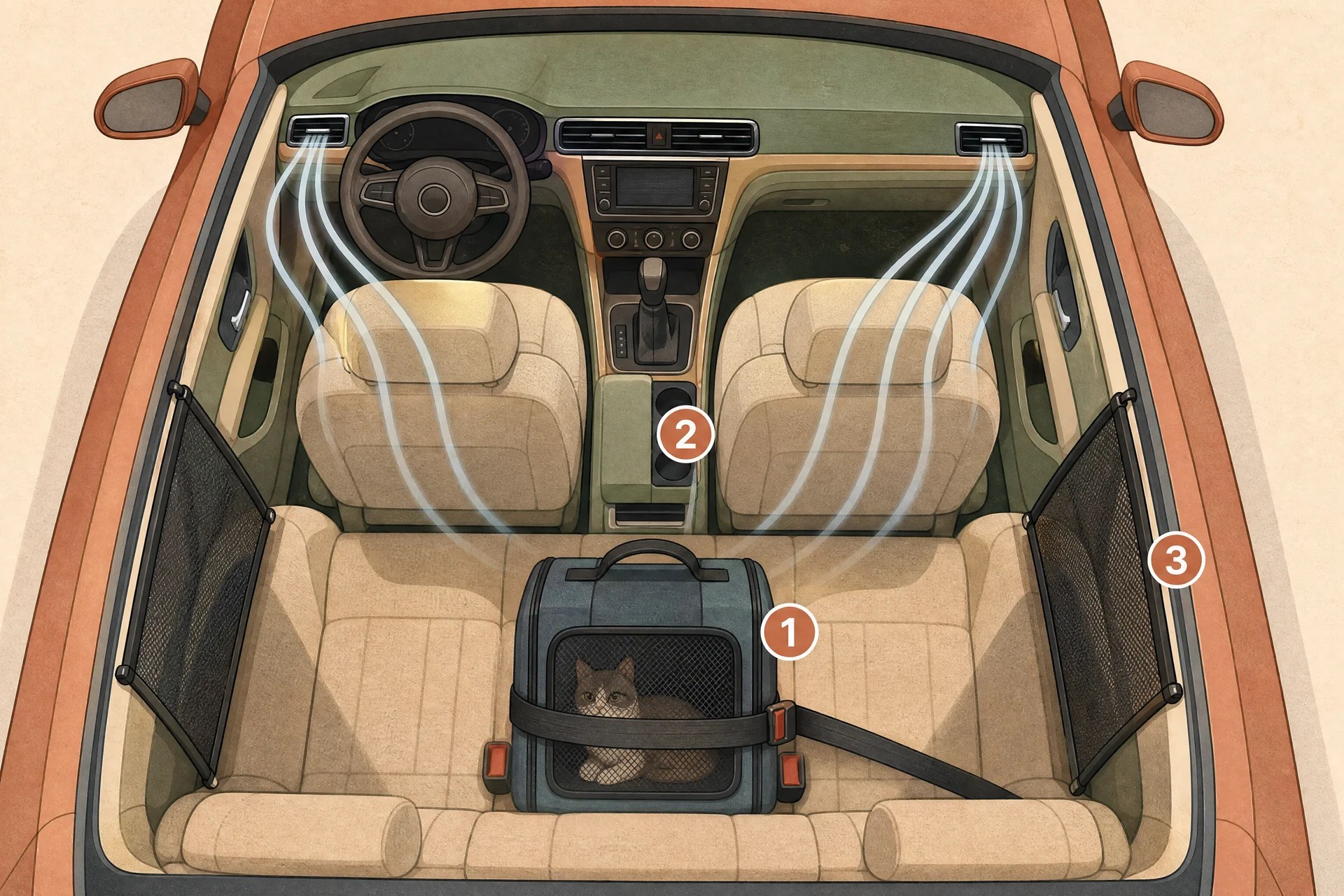
- Carrier in the middle of the back seat, secured. The AVMA asks for a carrier big enough to stand up, turn around and lie down in, positioned “as near to the center of the vehicle as possible,” and secured so it cannot move. The middle seat is also furthest from the side windows. Our cat carrier for car trips guide walks through the belt routing.
- Ventilation you can see through. The ASPCA’s car-travel advice is a “well-ventilated crate or carrier.” Mesh on more than one side lets cabin air in and lets you see the cat’s mouth without opening anything.
- Cool the car before the cat goes in. Run the air-conditioning for a few minutes first in warm weather. A car that has been sitting in a driveway can be hot inside even on a mild day.
- Short practice drives. The ASPCA recommends “a series of short drives first, gradually lengthening time spent in the car.” Merck says motion sickness can sometimes be overcome by conditioning the animal to travel. A cat whose only car trips end at the vet has learned exactly what the car means.
- A light meal, well ahead. The ASPCA’s schedule is a light meal three to four hours before departure and nothing in a moving vehicle. Pack an absorbent pad under the bedding too; frightened cats sometimes pee in the carrier, and we cover how to handle that and clean it properly separately.
- Know where the vets are on your route. On a long drive, save the nearest emergency clinic for each stretch before you leave, so the decision in step five takes seconds.
- Never leave the cat in the parked car. Not for a coffee, not in the shade. See below.
The parked car is the one situation with no grey area
Everything above assumes you are with the cat. If you are not, the maths changes fast. The AVMA’s vehicle safety page, citing research on children in vehicles, gives the temperature rise inside a closed car as about 19°F in 10 minutes, 29°F in 20 minutes and 43°F in an hour — and notes that the rise is “basically the same, whether 70 or 110 degrees outside,” that shade does not prevent it, and that “cracking the windows makes no difference.” On a 70-degree day that is more than 110 degrees inside within the hour. A cat in a carrier cannot move to a cooler spot. Take the cat with you, or do not make the stop. We cover the rules and numbers in more depth in is it safe to leave a pet in the car? — the physics are the same for a cat.
What about calming products or medication?
That is a conversation to have with your veterinarian before the next trip, not something to improvise. Merck notes that drug treatment can help prevent motion sickness and reduce drooling in some animals, but also that “some of the medications that treat motion sickness in dogs and people are not effective in cats,” and that your veterinarian can prescribe an appropriate one. The ASPCA, for air travel, warns that tranquilising a pet “is generally not recommended as it could hamper their breathing” — which is exactly the wrong direction for a cat that already pants in transit. Do not give a cat anything from your own medicine cabinet or the dog’s.
If your cat pants on every single trip, tell your vet that specifically. It is useful information whether the cause turns out to be fear or something else.
Cat panting in the car: FAQ
Is it normal for a cat to pant in the car?
It is common, especially on the way to the vet, but it is not something to ignore. Cornell’s Feline Health Center lists excessive panting as a sign of heat stroke in cats and noisy open-mouth panting as a sign of breathing difficulty. Treat it as a reason to cool the car, stop and check. If it stops quickly once the cat is cool and still, fear is the likeliest cause; if it does not, call a vet.
My cat is panting on the way to the vet. Should I keep driving?
Cool the car first. If the panting settles and your cat is alert, keep going and mention it at the appointment. If it continues, or your cat is drooling, vomiting, weak, holding its head low with the neck stretched out, or breathing noisily, call the clinic from the car so they can see your cat the moment you arrive — or go to the nearest emergency vet if yours is far away.
How long is too long for a cat to pant?
None of the veterinary sources we checked give a safe number of minutes, and we would be wary of any page that does. The practical test is whether it stops once you have removed the causes you can control — heat, motion, noise. If it does not settle after a few minutes of cool, quiet stillness, or if anything else is wrong, treat it as a breathing problem and get veterinary help.
Should I give my panting cat water?
Offer it once the cat has calmed and cooled, not by forcing it. For suspected heat stroke, the Merck Veterinary Manual says to offer small amounts of water once the body temperature begins to go down, and to take the pet to the vet right away.
Why does my cat start panting before the car even moves?
Because for many cats the car itself is the problem. Merck notes that fear of the vehicle may contribute to motion sickness in cats and that signs can appear even in a vehicle that is not moving. Short, uneventful practice drives that do not end at the vet are the standard way to change that association; ask your vet about anything beyond that.
Is a cat safe in a parked car for a few minutes with the windows cracked?
No. The AVMA cites a rise of about 19°F in the first 10 minutes whatever the outside temperature, and says cracking the windows makes no difference. A cat in a carrier cannot escape the heat.
Sources
- Cornell Feline Health Center — Feline heat safety (heat-stroke signs: weakness/collapse, excessive panting, drooling, vomiting, diarrhoea; cool area with a draft, wet the fur with cool not very cold water, contact your veterinarian immediately) (checked 2026-09-24)
- Cornell Feline Health Center — Dyspnea (difficulty breathing) (cats may pant noisily with an open mouth, cough, lower the head and extend the body; get to a veterinarian right away; high risk of dying if not treated promptly) (checked 2026-09-24)
- Merck Veterinary Manual — What to Do in a Dog or Cat Emergency (heat stroke is an emergency; signs include rapid panting and distress; some animals overheat from stress even on cool days; do not immerse in cold water; small amounts of water once temperature falls; calling ahead helps the clinic prepare) (checked 2026-09-24)
- Merck Veterinary Manual — Motion Sickness in Cats (salivation, vomiting, apprehension; fear of the vehicle may contribute and signs can occur in a vehicle that is not moving; conditioning can help; some dog and human medications are not effective in cats) (checked 2026-09-24)
- American Veterinary Medical Association — Pet safety in vehicles (interior temperature rise of about 19°F in 10 minutes, 29°F in 20 and 43°F in 60; cracking windows makes no difference; carrier secured near the centre of the vehicle) (checked 2026-09-24)
- ASPCA — Travel Safety Tips (short practice drives; well-ventilated, secured carrier; light meal three to four hours before departure; tranquilising generally not recommended for air travel as it could hamper breathing) (checked 2026-09-24)
This article is general information, not a diagnosis. If you are unsure whether your cat is breathing comfortably, call a veterinarian — that is always the right call.
Cool the car, stop, look. If it does not settle, call the vet.
A cat does not pant to cool off the way a dog does, so a panting cat in a carrier has earned five minutes of your attention. Most of the time it is fear in a warm box and it settles once you fix the temperature and stop moving. When it does not, or when anything else looks wrong, the answer is a veterinarian, not another mile. And the next trip starts before the engine does: a cool car, a carrier in the middle of the back seat, and a few short drives that do not end at the clinic.