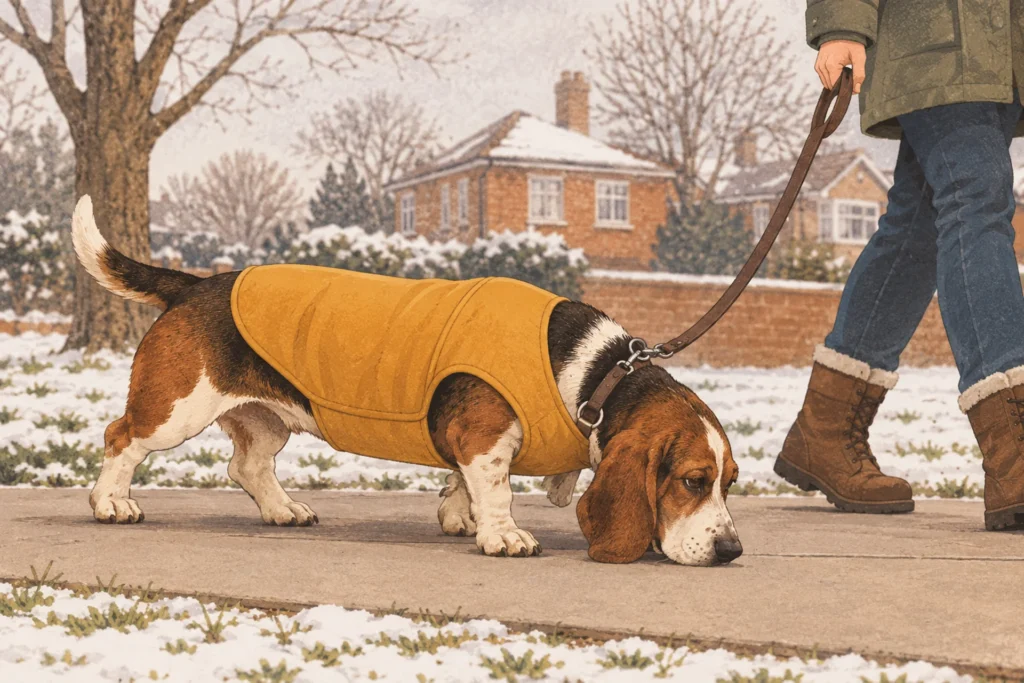
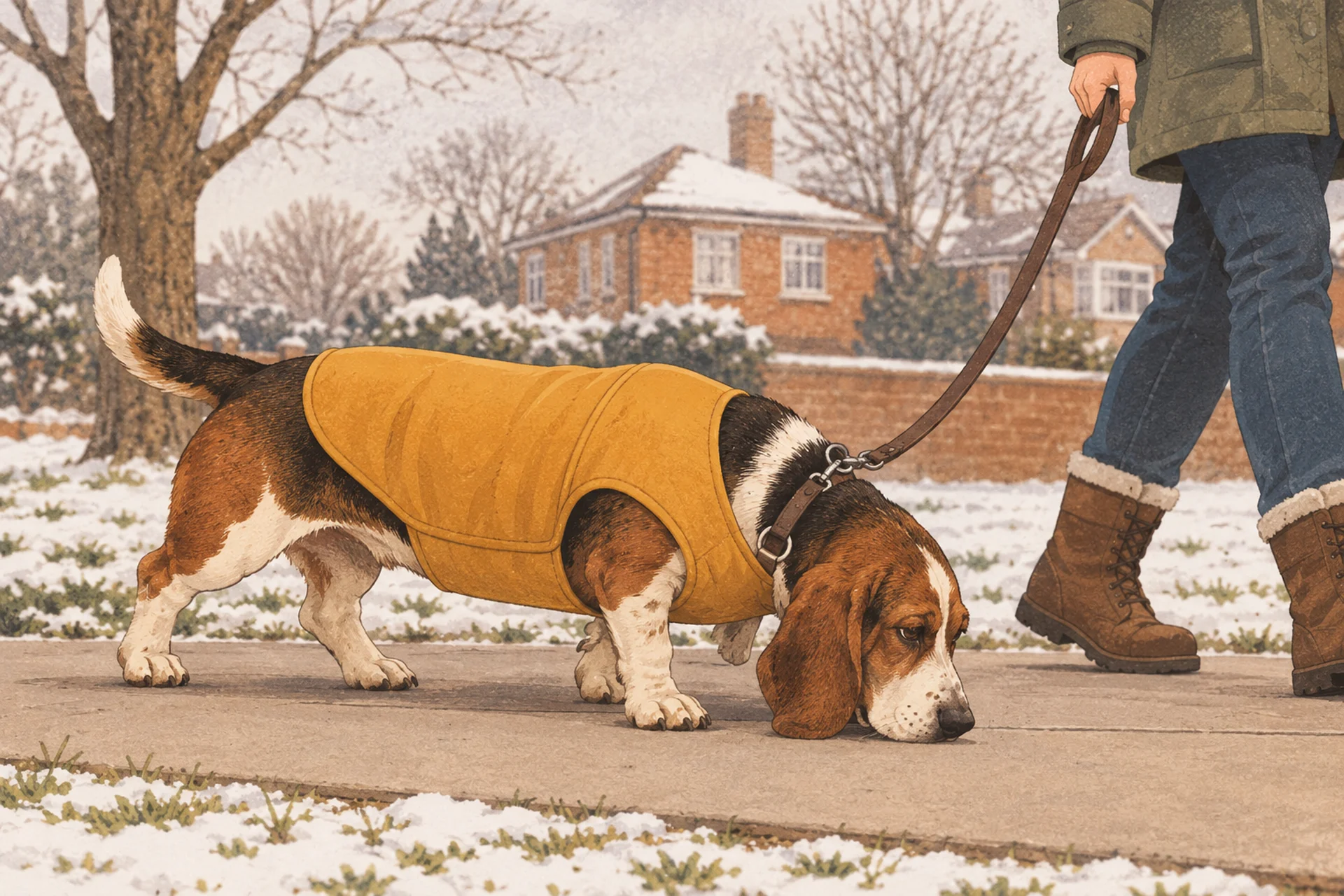
A winter coat can help a Basset Hound, but it has to fit the chest without getting in the way of the legs. The AKC specifically names Basset Hounds among low-slung dogs that can struggle when their bellies touch snow and ice. That is a reason to consider coverage underneath, not a rule that every Basset needs a heavy suit for every outing.
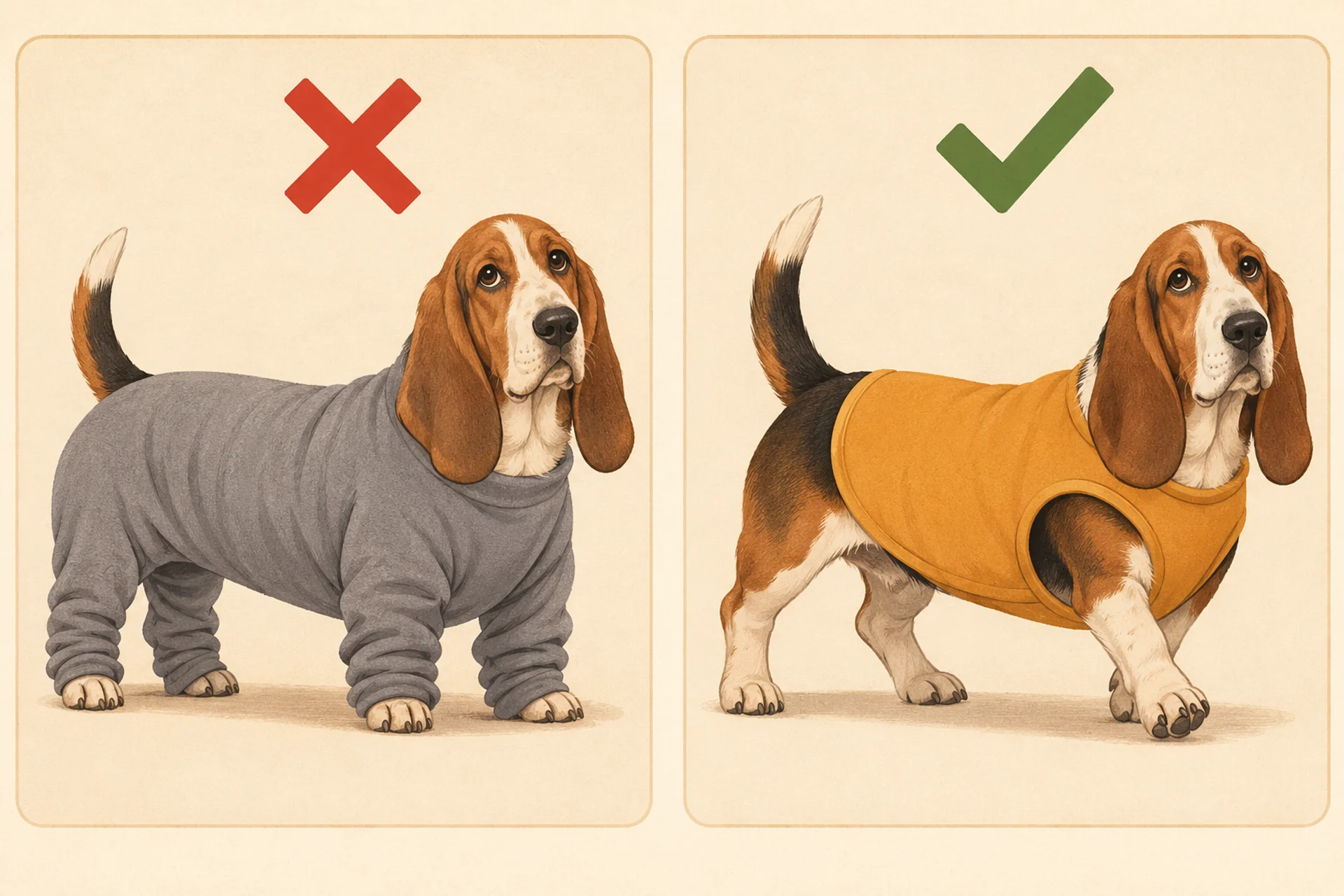
Start with your dog’s measurements and the garment’s shape. A chest fastening that closes is only the first test. The coat also needs to stay clear of the ground while your hound walks, lowers its nose and goes to the bathroom. If getting enough room around the ribs leaves sleeves under the paws, choose another cut rather than accepting the drag.
A Basset is low, not simply small
The official AKC breed standard describes a substantial, short-legged dog with a full, deep chest, a prominent breastbone and long ribs. It also describes loose skin, a pronounced dewlap and long, low-set ears. Those details explain why choosing the same label as another dog can be frustrating: room around the chest does not tell you where a sleeve or belly panel will finish.
Its natural coat is short and dense; do not mistake a short-haired Basset for a hairless dog. Equally, that coat description is not a winter walking limit. Cornell’s winter guidance says tolerance changes with age, condition, health, size and coat thickness. Make the decision for the hound in front of you, rather than assuming a sturdy body makes cold irrelevant.
Choose the job before the style
Pick a layer for the conditions, then check whether its shape works. A garment can fit beautifully and still be the wrong thing for the outing. The following is a shopping checklist, not a tested temperature chart.
| The outing | What to consider | What to check |
|---|---|---|
| Brief, mild, dry outing | A coat may be unnecessary for a comfortable adult dog | Do not add bulk just because it is winter on the calendar |
| Cold, dry walk | An appropriately warm jacket or sweater | Chest and back coverage without restricting movement |
| Wet winter ground or slush | Outerwear intended for wet conditions | Underside coverage that stays above the ground; follow the maker’s fabric and care information |
| Shivering, paw lifting or refusing to continue | A shorter outing and a warm, dry place | Do not treat a thicker coat as permission to keep going |
AAHA recommends covering the chest and back while allowing easy movement, and limiting outdoor exposure in extreme cold. A sweater’s appearance alone does not establish rain protection. Read the garment’s description instead of assuming that padding, quilting or a fleece lining tells you how the outside handles water.
Measure the hound, then question the cut
The AKC’s raincoat fitting guide recommends measuring the neck, chest, stomach and body length, and warns that weight alone does not reliably predict clothing fit. Use the measurement locations specified by the particular maker. Our guide to measuring a dog for clothes explains how to record measurements before comparing charts.
Send the seller the measurements together. Ask about sleeve length and the lower edge of the belly panel if neither appears in the chart. A photo of a coat on a taller dog cannot answer those questions. If chest and back measurements point to different sizes, ask for help or choose another pattern; there is no reliable universal rule to always size up or always choose the chest size.
A sleeveless cut is worth comparing when a full suit has excessive leg fabric. That is a practical starting point, not a claim that sleeves are inherently unsafe or that every sleeveless coat fits a Basset. You still need to check the opening around each front leg and the coverage underneath.
The try-on happens in motion
A still photograph can hide a poor fit. AAHA advises checking for pinching or rubbing and removing clothing if it causes stress. Use a short, supervised try-on on a clear floor before taking the coat outside.
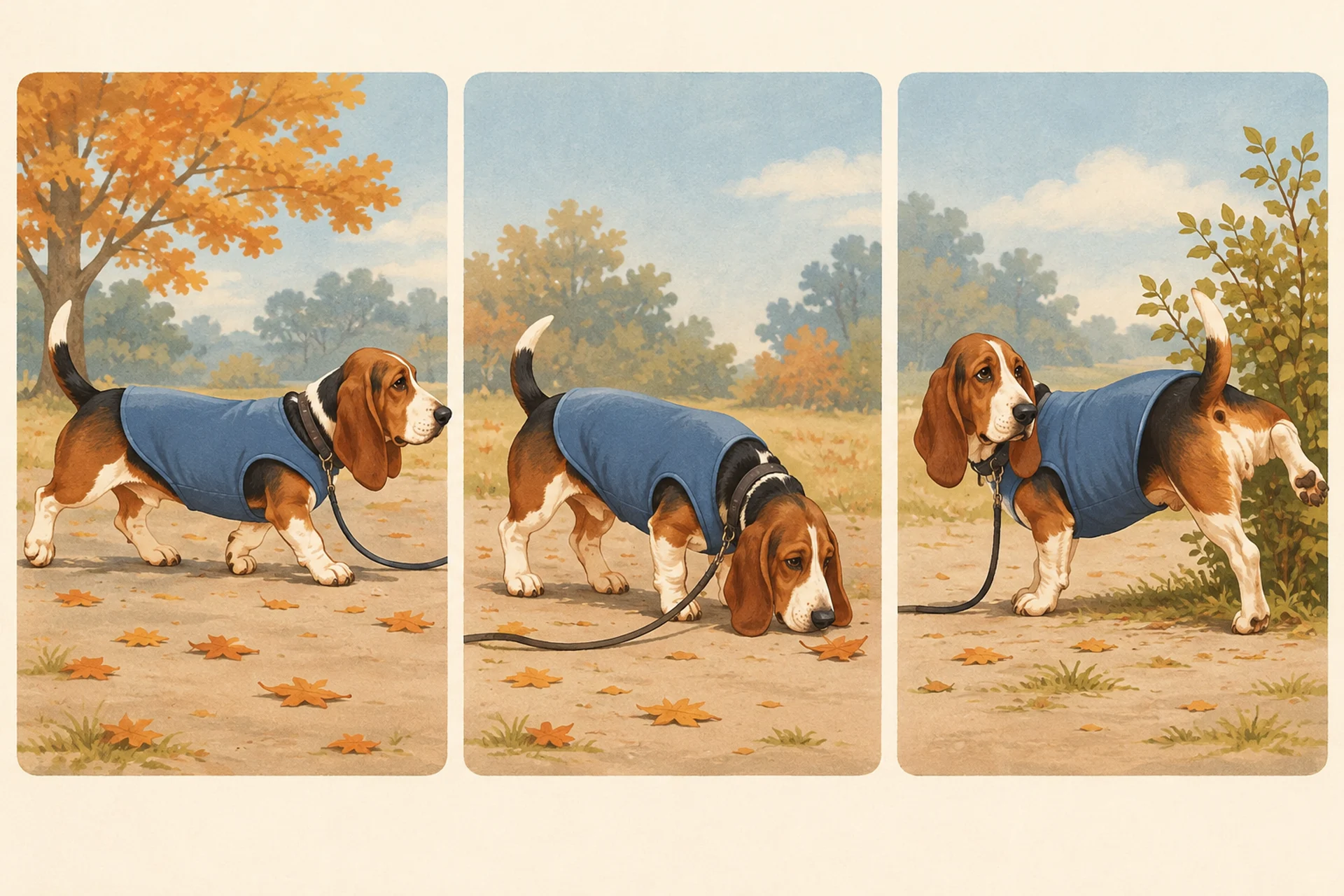
- Walk and turn. Watch whether the front legs move freely or catch the fabric. Repeatedly adjusting the coat is a reason to reassess it.
- Lower the nose. Let your hound sniff. Check that the neckline does not pull tight over the loose skin beneath the neck, and that ears are not caught in a fastening.
- Look from the side. Check clearance under the chest and belly while the dog moves, not only while standing upright.
- Check bathroom access. Make sure the rear and belly openings leave the dog’s usual toileting posture unobstructed.
- Try the walking equipment. A harness and coat must work together without forcing an awkward leash route. Do not assume a decorative coat ring is a restraint attachment.
- Take it off and look again. Check for areas that have pressed or rubbed. Stop using that fit if your dog seems uncomfortable.
These are observations to make, not a substitute for a maker’s fitting instructions. Our general coat try-on guide covers the rest of the fitting process. Keep any medical restrictions from your veterinarian in mind. A winter coat is clothing, not a brace or a treatment.
The coat comes off when the walk ends
The ASPCA recommends drying pets when they come inside and washing and drying feet and stomach after winter walks to remove ice, salt and chemicals. Check beneath the coat too. Do not put a damp garment straight back into service without following its care instructions and letting it dry.
Shivering, a tucked posture, paw lifting or reluctance to walk are reasons to move into warmth, according to Cornell. Suspected hypothermia or frostbite needs immediate veterinary attention. For a puppy, senior or dog with a health condition, ask your veterinarian about suitable weather limits. Clothing does not make an otherwise unsuitable outing safe.
Basset Hound winter coat FAQ
Do Basset Hounds need winter coats?
Some benefit from one, especially when their low chest and belly meet snow or wet ground. The AKC names the breed in its winter coat guidance. Decide from the weather and the individual dog’s comfort, age and health rather than using a breed-wide temperature rule.
What size coat does a Basset Hound wear?
There is no size label that reliably fits every Basset. Measure for the maker’s chart, then ask about sleeve and underside length. A breed name or weight range does not establish ground clearance.
Should I buy a bigger coat for a deep chest?
Only if the larger garment also fits elsewhere. Check what happens to the neckline, back, belly panel and sleeves. If those become excessively loose or drag, look for a different cut instead of accepting one good measurement and several poor ones.
Is a sleeveless coat better than a four-leg suit?
It can avoid the particular problem of sleeves that are too long, but offers different coverage. Try both cuts against your dog’s movements and the outing’s needs. More fabric is not automatically a better fit.
Does a Basset’s winter coat need a hood?
A hood is not the first fitting priority. Start with body coverage and free movement. If you try one, check that your dog can see, sniff and move normally, and that the ears remain comfortable. Do not choose it on a promise of preventing ear disease.
What if my Basset stops walking in the coat?
Check the fit and remove it if it causes distress. A new garment may need a gradual introduction; a sudden change, pain or continuing reluctance without the coat deserves veterinary advice. Do not pull the dog along to finish the fitting test.
Sources
- American Kennel Club — Does My Dog Need a Winter Coat? (checked 2026-11-06)
- American Kennel Club — Official Standard for the Basset Hound (checked 2026-11-06)
- Cornell University College of Veterinary Medicine — Winter safety tips (checked 2026-11-06)
- American Animal Hospital Association — Cold Weather Pet Safety Tips (checked 2026-11-06)
- American Kennel Club — Dog raincoat fitting guidance (checked 2026-11-06)
- American Animal Hospital Association — Frosty walks (checked 2026-11-06)
- ASPCA — Cold Weather Safety Tips (checked 2026-11-06)
Written and source-checked by Codex (OpenAI), November 6, 2026.
This is general guidance, not a diagnosis or an individual cold-weather prescription. Ask your veterinarian about your dog’s health and weather limits.