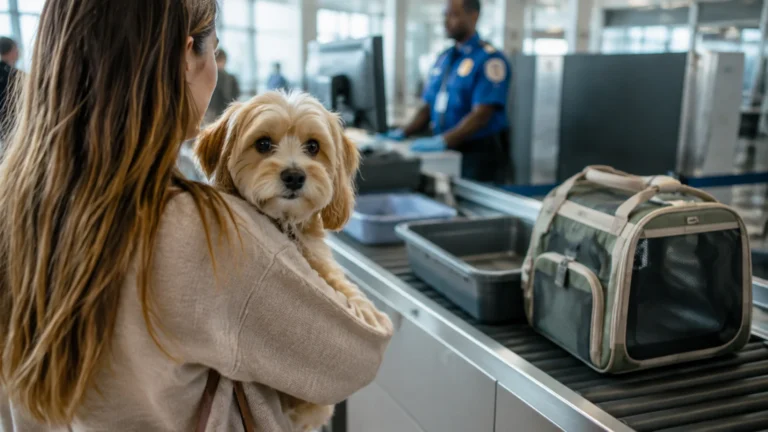
The size of dog that can fly in the cabin is set by the carrier, not the scale. On almost every major airline in North America the rule is the same: your dog has to fit inside a closed carrier that fits under the seat in front of you, and be able to stand up and turn around inside it. That usually means a dog of roughly 15 lb or less, sometimes up to about 20 lb for a compact build — and practically never a medium or large dog.
The “20 lb limit” you keep reading is mostly folklore. United says it outright — “there are no weight or breed limitations for pets” — and Delta, Southwest, JetBlue, Frontier and Air Canada publish no pet weight limit either. American publishes a 20 lb combined limit, but only for one aircraft type. What every one of them does publish is a carrier size, and those sizes differ by several inches.
So the honest answer for a 15 lb dog is usually yes, for a 20 lb dog it is it depends on your dog’s shape, and for a 25 lb or larger dog it is almost always no — unless the dog is a trained service dog, which is a different set of rules. Measure the dog, measure the bag, and check your specific airline, because these policies change.
What the FAA requires — and what it doesn’t
Start above the airlines, because it clears up a lot of confusion. The FAA’s page on flying with pets is blunt about who decides: “The FAA allows each airline to decide if they will allow you to travel with your pet in the passenger cabin.”
Where the FAA does have a rule, it is a stowage rule, not an animal rule. If an airline permits cabin pets, the container counts as carry-on baggage under 14 CFR 121.589, and it must “be small enough to fit underneath the seat without blocking any person’s path to the main aisle of the airplane,” be stowed before the boarding door closes, and stay stowed while the aircraft is moving.
Read that list again and notice what is missing. There is no federal weight limit for a cabin pet. There is no federal carrier certification either — which is why you should treat the phrase “airline approved” on a product listing as marketing language rather than a credential. The FAA does not approve pet carriers. Airlines set their own numbers, and those numbers are the ones that matter at the gate.
What size dog can fly in the cabin on each airline
These are the figures on each airline’s own policy page, checked on the date in the Sources block below. They change — sometimes quietly — so confirm before you book rather than before you pack.
| Airline | Published soft-sided carrier max | Weight limit published? | Cabin fee, each way |
|---|---|---|---|
| Delta | 18 × 11 × 11 in (recommended; actual max varies by aircraft) | No | $150 domestic, $200 international |
| American | 18 × 11 × 11 in (hard-sided 19 × 13 × 9 mainline, 16 × 12 × 8 on American Eagle) | Only on the 3-cabin Airbus A321T: 20 lb pet + carrier, weighed at check-in | $150 |
| Southwest | 18 × 10.5 × 10 in (their own branded carrier is 15 × 10 × 10) | No | See Southwest’s current fee page |
| JetBlue | 17 × 12.5 × 8.5 in | No — but “only small dogs and cats,” no large dogs at all | $150 |
| United | 18 × 11 × 11 in (hard-sided 17.5 × 12 × 9) | No — “no weight or breed limitations” | $150 |
| Frontier | 18 × 14 × 11 in soft-sided (18 × 14 × 8 hard-sided) | No | Charged one-way, payable at booking |
| Air Canada | 17 × 16 × 8 in on mainline jets (22 × 16 × 10 on regional aircraft); soft-sided only | No — “cat or small dog” that can stand, turn and lie down | CA/US $50–60 within Canada and Canada–US |
Two things jump out of that table. First, the height figures are the tight ones — JetBlue’s 8.5 inches and Air Canada’s 8 inches on its mainline jets are barely more than two-thirds of the 11 inches Delta, United and Frontier allow. A carrier that sails onto a United flight can be refused at an Air Canada gate, and on Air Canada the same dog can fit on a regional plane and not on a jet. Second, only one airline in the group publishes a weight number at all.
If you are flying from Canada, note that Air Canada’s pet page has required soft-sided carriers in the cabin since June 1, 2025, rules out backpack carriers with hard plastic windows, and says a pet “could be refused travel if the carrier is deemed to be too small for them.”
So where does “20 pounds” come from?
It is not invented. American’s pet policy states it plainly: “The total weight of your pet and its carrier must not exceed 20 pounds (9.07 kilograms). We will weigh them at check-in.” The detail everyone drops in the retelling is where that sentence sits — in the row for the three-cabin Airbus A321T, in a table of limits by aircraft type. It is a constraint for one configuration, not American’s universal rule, and it is not Delta’s or Southwest’s rule at all.
The number then spread because it is convenient. A weight is easy to write, easy to compare and easy to put in a product listing. A rule that reads “must fit under the seat of whichever aircraft you happen to be assigned, and be able to stand up and turn around” does not fit in a table cell. So the industry rounded a real but narrow figure into a fake general one, and a decade of buying guides copied it.
The practical consequence cuts both ways. Some owners of 22 lb dogs never try, because they read that they cannot. Others buy a bag on a “up to 25 lbs” listing, arrive at the gate, and discover the problem was never the scale — it was that the dog could not stand up inside the bag with the zip closed.
The test that actually decides it
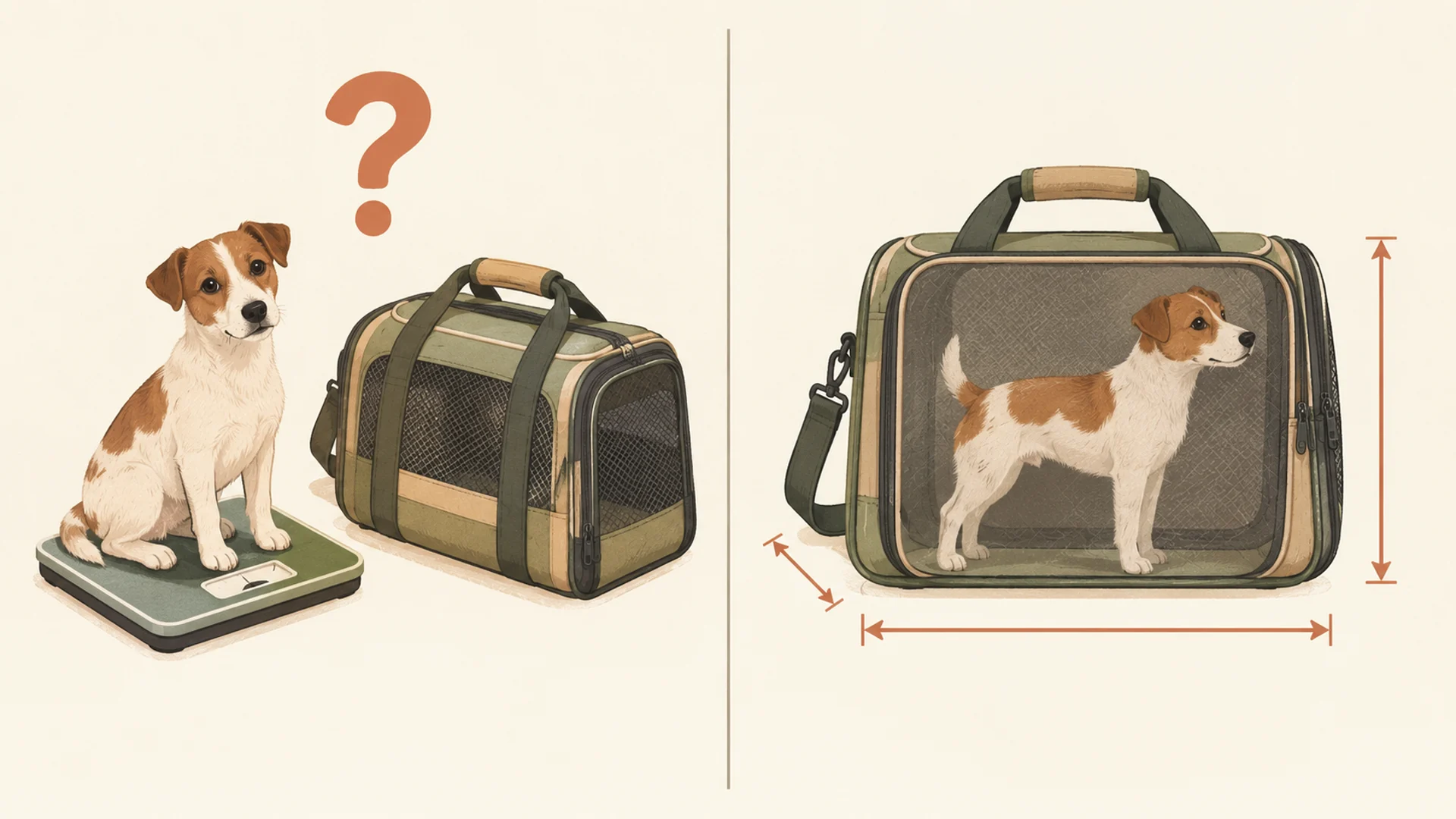
Every airline in the table above states some version of the same requirement, and it is the one you should rehearse at home. Southwest’s wording is the most specific: the cat or dog, “including head and tail,” must be completely inside the carrier and “be able to stand up and move around the carrier with ease.” American’s is shorter: pets “must be small enough to fit comfortably inside the closed / zipped carrier.” JetBlue’s asks that the pet “be able to turn around comfortably when it’s closed.” Air Canada’s adds lying down: the carrier must let the pet “stand up, turn around and lie down safely and comfortably, with no part of them extending outside the carrier.”
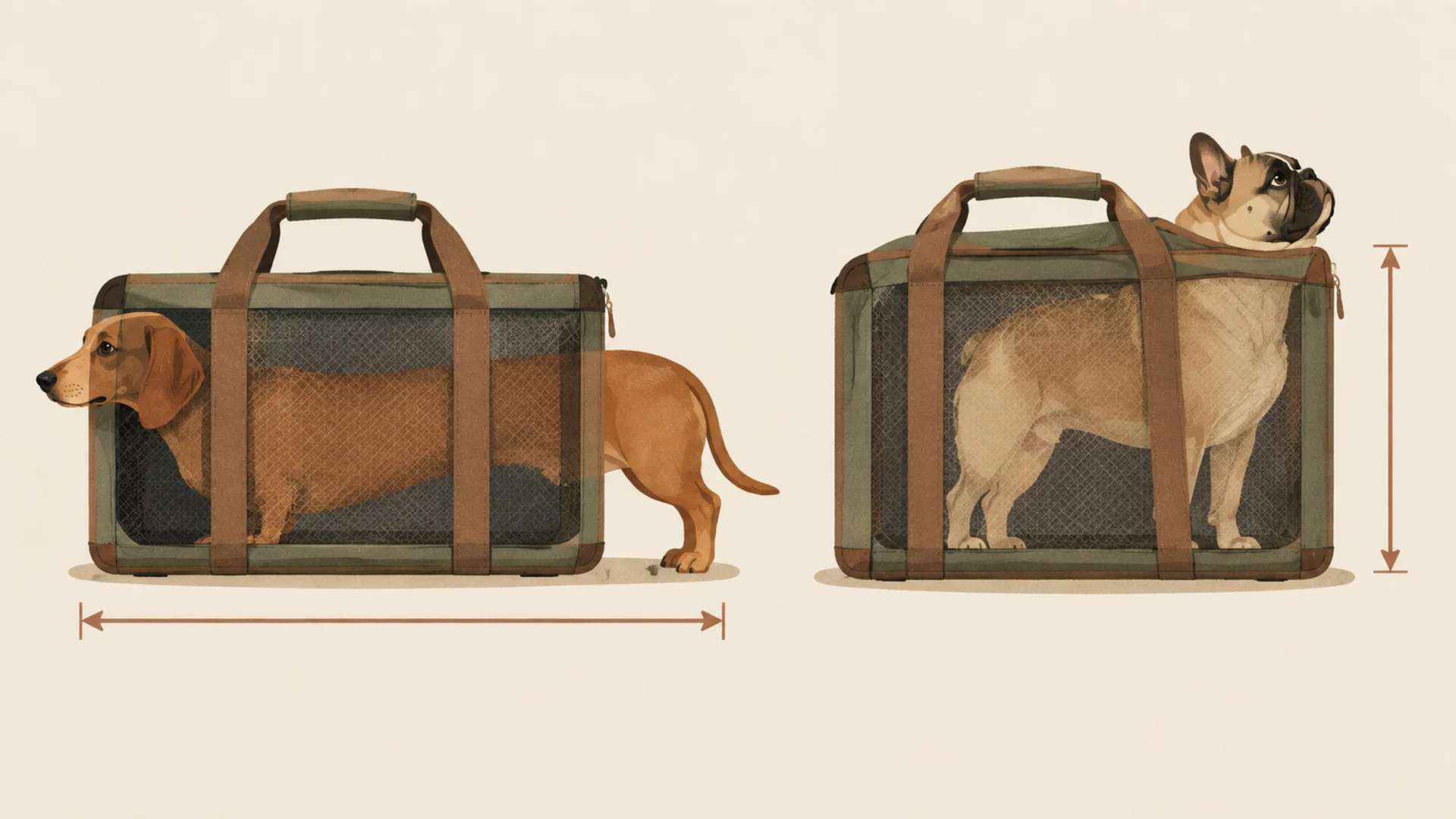
That is a shape test, not a weight test. A 20 lb dachshund and a 20 lb French bulldog fail and pass it in completely different ways — one is too long for the bag’s floor, the other too tall for its ceiling. Two dogs, same scale reading, opposite problem.
Do it this way, in this order, before you buy anything:
- Measure your dog standing: nose-to-tail-base length, and floor-to-top-of-shoulder height. Add a couple of inches to the height — dogs stand taller when they are unsettled.
- Look up your airline’s published carrier dimensions for the aircraft on your itinerary, not the generic figure.
- Compare the carrier’s interior against your dog’s numbers, and its exterior against the airline’s.
- Then, and only then, worry about weight — and only if you are flying American on an A321T.
Our carrier sizing page walks through the same three measurements with pictures, and the airline compliance page tracks how the major carriers state their limits.
Reading it back for your dog’s weight band
| Dog weight | Realistic outlook | What decides it |
|---|---|---|
| Under 11 lb | Works on every airline above | Mostly the carrier’s height on JetBlue and Air Canada jets |
| 11–15 lb | Usually works | Carrier height versus your dog’s standing height |
| 16–20 lb | Often works, contrary to the folklore | Body shape, and whether your itinerary includes an American A321T, a JetBlue flight or an Air Canada jet |
| Over 20 lb | Rarely works, but for a different reason than you were told | Not the weight — the dog cannot stand and turn inside a bag that fits under a seat |
TuckTrail pick
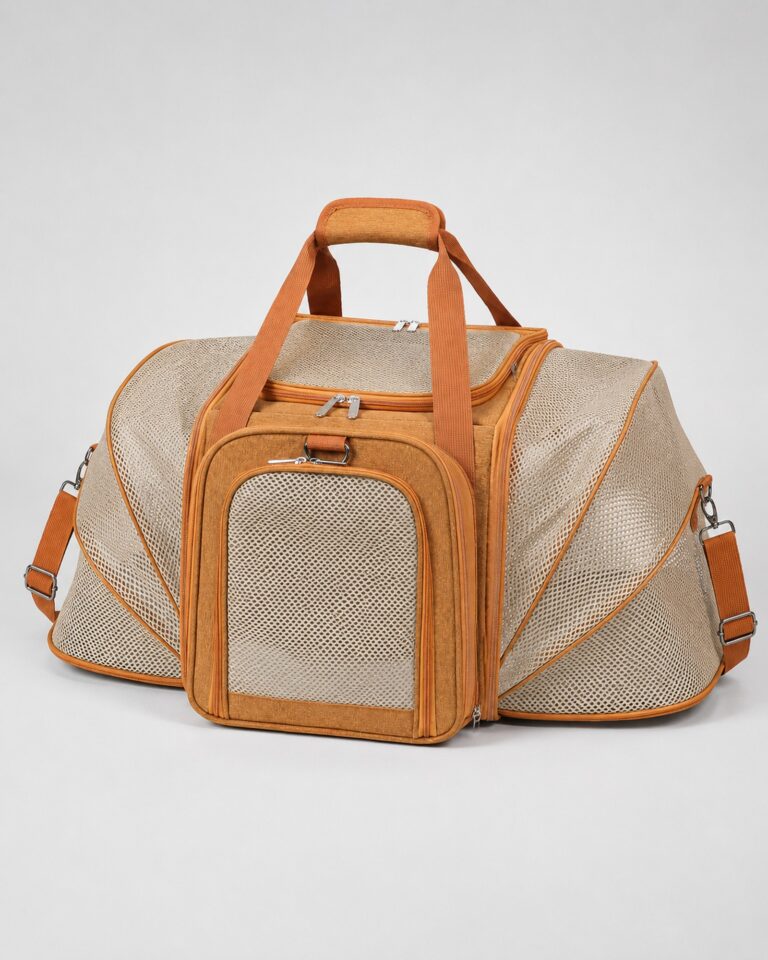
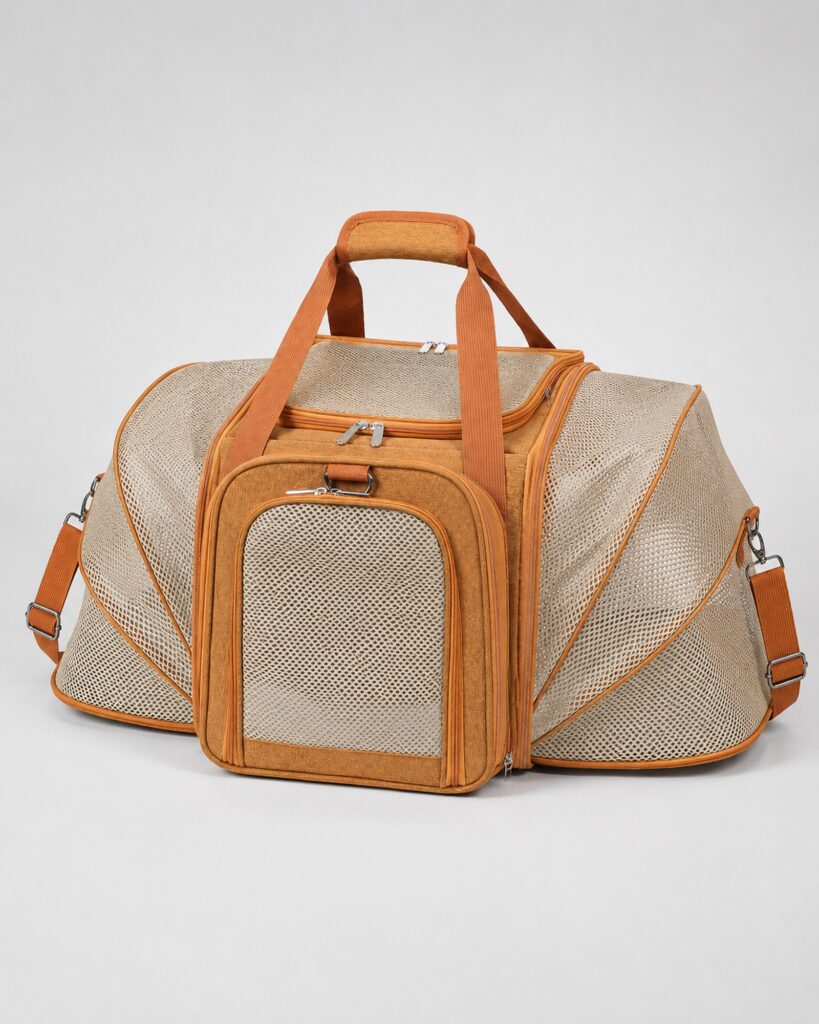
The Sky Double-Expand Mesh Pet Travel Carrier measures 18.1 × 11 × 11 in, weighs about 3 lb and is rated for pets up to 15.4 lb. Note the honest caveat that applies to every soft-sided bag on the market: at 18.1 inches long it sits a tenth of an inch over the 18-inch figure Delta, American and United publish, and at 11 inches tall it is well over the 8 to 8.5 inches JetBlue and Air Canada’s mainline jets allow. Soft sides compress, and gate agents are looking at whether it stows, not at a tape measure — but compare it against your own airline’s current number before you book, not after.
Can a large dog fly in the cabin?
As a pet, no. A 25 lb, 30 lb or 60 lb dog is not going to fly in the cabin on a major US or Canadian airline, and no carrier purchase changes that. The limit is not a weight rule; it is that a bag big enough for that dog to stand and turn in will not fit under an airline seat.
The one real exception is a trained service dog, which travels under different rules. Under the Air Carrier Access Act, the US Department of Transportation defines a service animal as a dog “individually trained to do work or perform tasks” for a person with a disability, and says emotional support and comfort animals are not service animals. A service dog rides in the foot space in front of your seat rather than in a carrier, but it must not block the aisle or an exit, airlines may ask for DOT forms, and they may still refuse a dog that is “too large or heavy to be accommodated in the cabin.” Emotional support animals fly as ordinary pets, carrier rules included.
For dogs over the line: the honest answer
For everyone else with a mid-size or large dog, the cabin is not the route. Products marketed as “airline approved” at that size are generally built for checked or cargo programs, which are separate services with their own rules, seasonal temperature embargoes and eligibility restrictions. American, for instance, accepts checked pets only for active-duty US military and State Department Foreign Service personnel on official orders.
Most families with mid-size dogs get more days out per year from the road than from fighting cabin policy. A properly secured car setup — see our guide to dog car travel — plus destinations within driving range usually beats the alternative. Our Drive collection is built around those trips. If your dog is at the older end of the range, what changes when you travel with a senior dog is worth reading first.
Before you book
- Weigh your dog on a home scale this week rather than from memory — you will want the number even if the airline never asks for it.
- Measure standing height and body length, and add margin to the height.
- Find your airline’s current pet page and note the carrier dimensions for your aircraft type, not the generic figure.
- Check whether cabin pets are permitted on your route at all — several airlines exclude Hawaii, trans-Atlantic and trans-Pacific flights entirely.
- Confirm the per-flight cap on pets in the cabin and reserve early; it is usually a small number and it is first-come.
- Practise at home until your dog will settle in the closed bag for the length of the flight, not the length of a photo.
- Do not sedate. American declines sedated pets outright, citing AVMA guidance on the respiratory and cardiovascular risks at altitude.
Weight and airline carrier FAQ
Is there really a 20 lb limit for dogs in the cabin?
Not as a general rule. Of the seven airlines checked for this guide, only American publishes a 20 lb combined pet-and-carrier figure, and it appears in the row for the three-cabin Airbus A321T rather than as a blanket policy. Delta, United, Southwest, JetBlue, Frontier and Air Canada publish carrier dimensions and no weight limit. Always confirm on your own airline’s page, since these policies change.
What size dog can fly in the cabin?
Generally a dog that fits in a closed soft carrier of about 18 × 11 × 11 inches or smaller and can stand up and turn around inside it — in practice, most dogs up to around 15 lb and some compact dogs up to around 20 lb. The exact carrier size depends on the airline and the aircraft, from 8 inches tall on Air Canada’s jets to 11 inches on Delta, United and Frontier.
What size dog can fly in the cabin on United?
United publishes no weight or breed limit. The dog must travel in a soft-sided carrier up to 18 × 11 × 11 inches or a hard-sided one up to 17.5 × 12 × 9 inches, which must fit under the seat in front of you. The pet fee is $150 each way, and United does not carry pets to or from Hawaii.
Can a 25 lb dog fly in the cabin?
Rarely, and not because of the number. Very few 25 lb dogs can stand up and turn around inside a carrier small enough to fit under an airline seat. A trained service dog is the exception, since it travels at your feet under DOT service animal rules rather than in a carrier.
Can a 20 lb dog fly in the cabin?
Sometimes, and it depends on build rather than the scale. The universal requirement is that the dog fits inside the closed carrier and can stand up and turn around in it, while the carrier fits under the seat. A compact 20 lb dog can pass that test; a long-backed or tall 20 lb dog often cannot.
Is there an “airline approved” carrier for a 25 lb dog?
No, in two senses. There is no such thing as an FAA-approved pet carrier — the FAA leaves cabin pets to each airline — and at 25 lb the animal will generally not be able to stand and turn inside a bag that still fits under a seat. Listings using that size and that phrase are usually describing checked or cargo kennels.
Does the carrier’s own weight matter?
Only where a combined limit is published, which on the airlines above means one American aircraft type. Everywhere else, a lighter bag is worth having for your shoulder on a long connection, not for the policy.
My dog is 15.4 lb exactly — which capacity rating do I need?
Stay at or under the carrier’s own rated capacity, but treat that rating as a structural statement about the bag rather than an airline threshold. If your dog sits right at a carrier’s maximum, they will likely be cramped on a long day; the fit test above matters more than the rating.
Will the gate agent measure my carrier?
Usually they check that it stows under the seat, which is the FAA requirement they are actually enforcing. But policies allow them to check dimensions, and on American’s A321T the pet and carrier are weighed at check-in. Plan for the published rule, not for the odds.
Bottom line
The number you have been told to worry about is mostly not the one being enforced. Weigh your dog by all means, then put the scale away and measure them instead — length, standing height, and whether they can turn around inside the closed bag. That is the test in the policies, on every airline in the table, in almost identical words. Get that right and the weight column takes care of itself.
Sources
- Federal Aviation Administration — Flying with Pets (checked 2026-09-09)
- American Airlines — Traveling with pets (checked 2026-09-09)
- Delta Air Lines — Pet travel overview (checked 2026-09-09)
- Southwest Airlines — What type of pet carrier can I bring? (checked 2026-09-09)
- JetBlue — Traveling with pets (checked 2026-09-09)
- Frontier Airlines — Family & pets (checked 2026-09-09)
- United Airlines — Traveling with pets (checked 2026-09-26)
- Air Canada — Travelling with your pet (checked 2026-09-26)
- US Department of Transportation — Service animals (checked 2026-09-26)
Airline pet policies change, and several of the figures above vary by aircraft type on the same airline. Always confirm on the official page for your specific flight before you book.