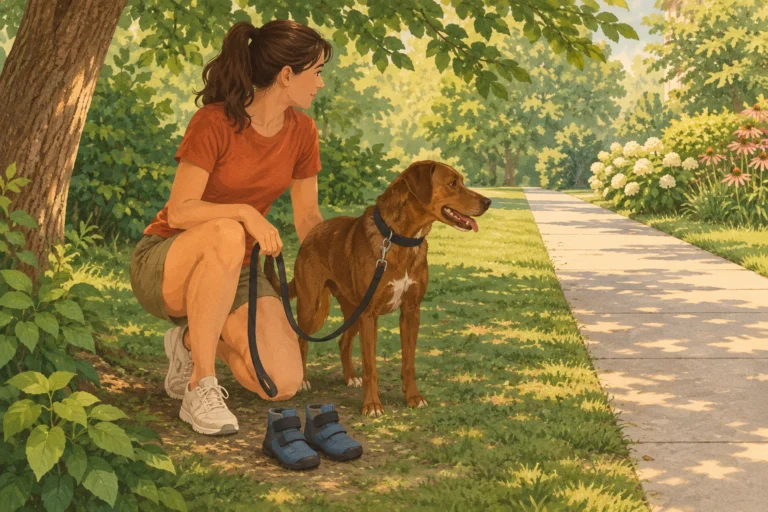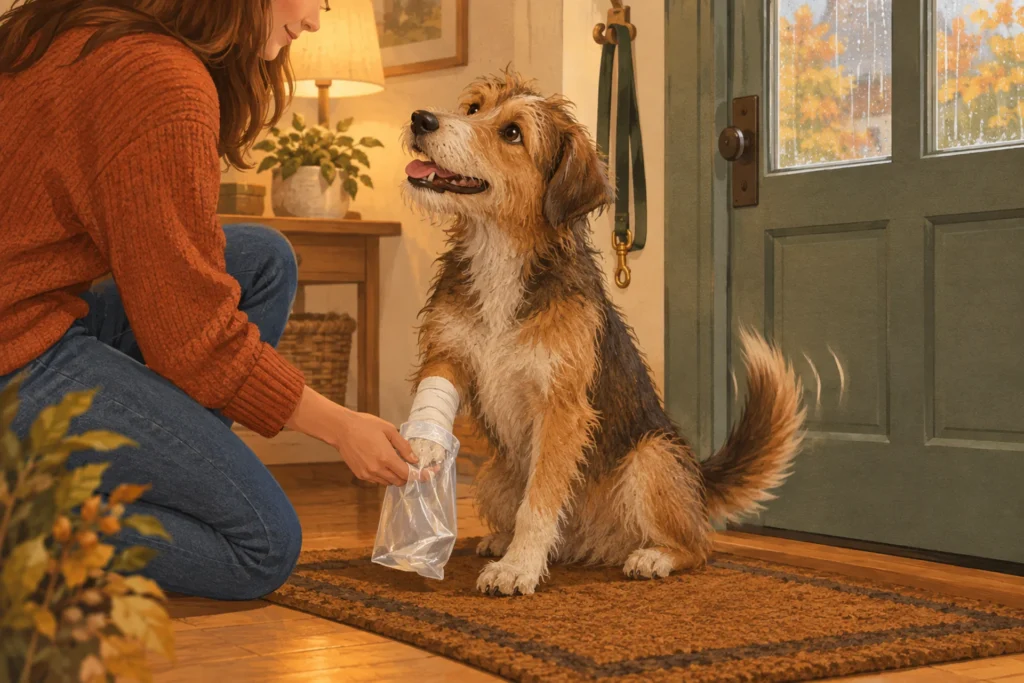
Cover it only for the trip outside, and take the cover off the moment you’re back in. VCA Animal Hospitals’ instruction is to cover the bandage with a plastic bag or a protective bootie whenever your dog goes outside, with your dog on a leash and supervised. The Animal Medical Center in New York says the same and adds the half people miss: remove the bag or boot immediately when you come back indoors, because left on, it makes the bandage soggy from the inside.
Stitches with no bandage are simpler and stricter: don’t let the incision get wet. In the rain that means short, leashed bathroom trips and nothing more until your vet clears it. And if a bandage does get wet, don’t wait for it to dry. Call the clinic. Your vet’s discharge sheet beats anything here; this is the rainy-day version of it.
Why a damp bandage matters more than a wet dog
A wet dog dries. A wet bandage doesn’t, at least not where it counts. The padding layers soak up water and hold it against the skin, under a wrap you can’t see through. The AMC’s Dr. Ann Hohenhaus puts it plainly: a wet bandage can hold moisture against the skin, and a serious infection and skin ulceration can develop out of your sight.
The wrap itself suffers too. The American College of Veterinary Surgeons notes that for bandages, splints and casts, exposure to moisture can weaken the materials and increase the risk of skin infection. A bandage that has gone soft and heavy is more likely to slip, and a slipping bandage stops doing its job.
That’s why the advice isn’t “towel it off when you get in.” By the time you can feel damp on the outside, the inside has been wet for a while. The whole point of the routine below is to stop water reaching the bandage in the first place, and to stop the cover itself becoming the problem.
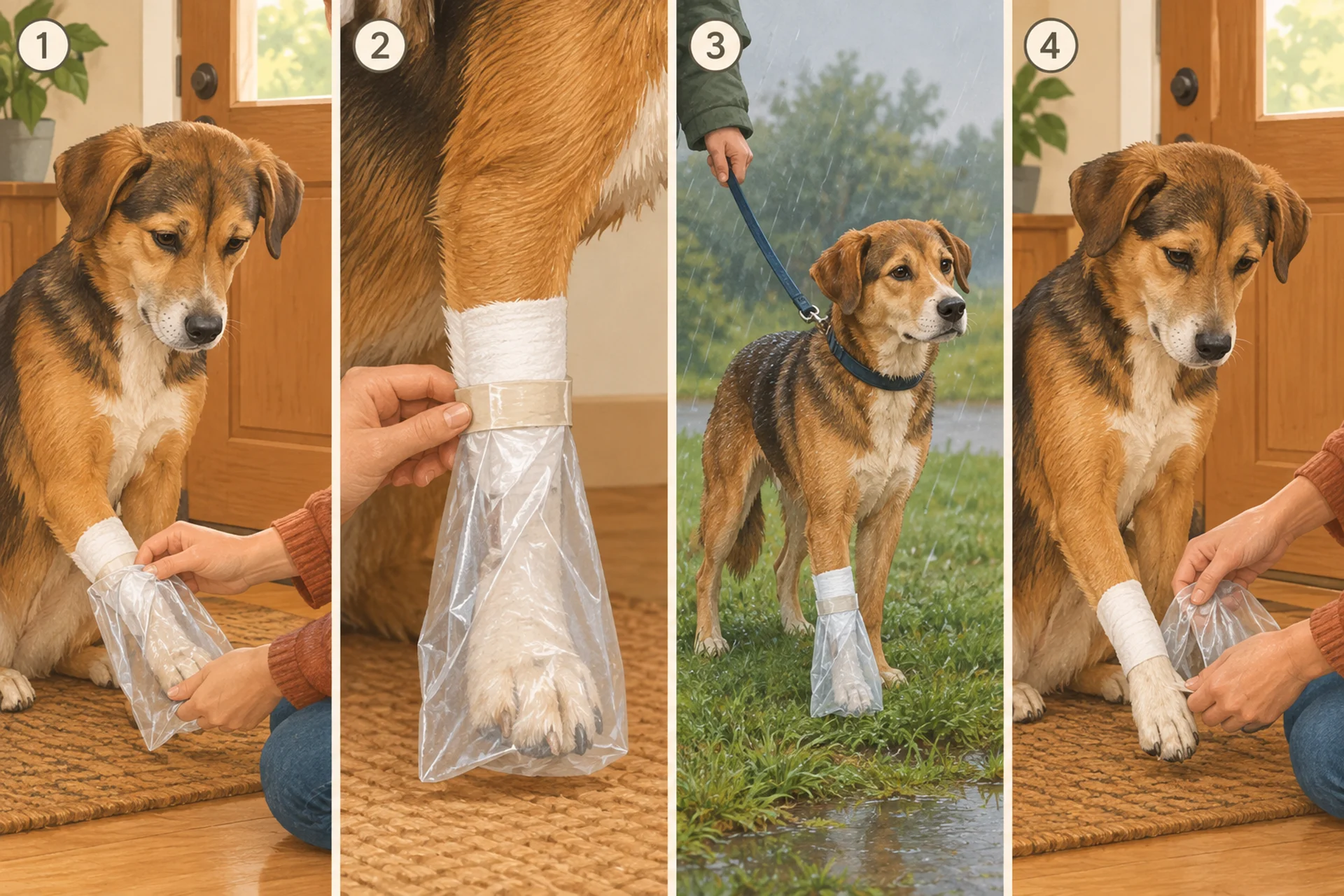
Paw and leg bandages: the cover routine
Most rainy-day bandage problems are on a foot or a lower leg, because that’s the part that meets the wet grass. You don’t need special gear to protect it. What you need is a cover that keeps water out for ten minutes and a habit of taking it off again.
| Cover | What the vets say | Watch out for |
|---|---|---|
| Plastic bag, taped over the bandage | VCA’s foot-pad guidance is to keep the bandage dry by taping a plastic bag over it when the dog walks on wet grass. The AMC specifies a heavy-duty bag | Thin bags tear on the first stick or claw. Secure the top over the bandage, not tight around bare leg, and ask your vet how they’d like it fastened |
| Protective bootie | VCA lists a bootie alongside the bag as a way to keep the bandage from getting wet or soiled outdoors | It has to go over the bandage without squeezing it. If you have to force it on, it’s too small for a bandaged foot |
| Waterproof boot for longer recoveries | For long-term bandages the AMC suggests considering a waterproof boot, but only if your veterinarian approves | Same rule as the bag: off as soon as you’re indoors. A boot left on traps moisture just like plastic does |
Then keep the trip short. VCA’s bandage instructions are that your dog must not go outside unless leashed, with the bandage covered, and supervised, and that exercise stays restricted. The ACVS says dogs recovering from surgery should go out on a leash for bathroom breaks only unless your vet says otherwise. A rainy day is not the day to stretch that. Go to the nearest patch of grass, let your dog do what it went out for, and come back in.
If your dog already hates going out in the rain, that short trip can turn into a standoff on the doorstep. Our guide to a dog that won’t go potty in the rain has the routine for that, and most of it works fine on a leash with a bagged paw.
Back inside: the two-minute check
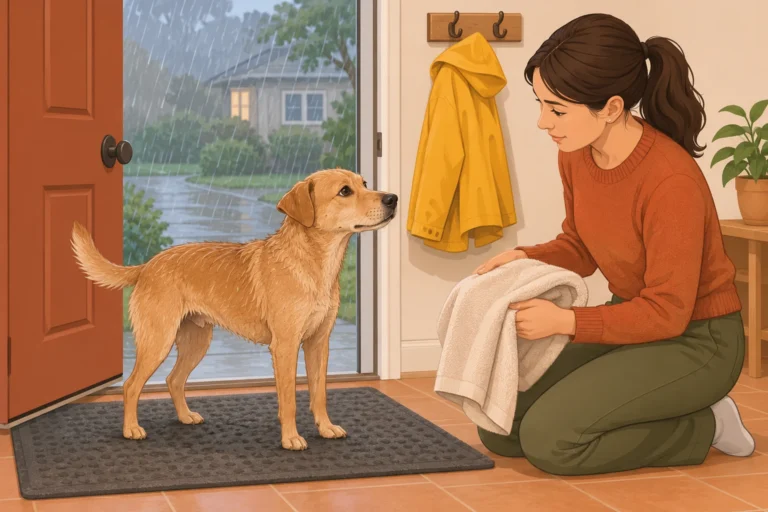
Take the cover off on the mat, before your dog heads for the sofa. Wipe the bag, not the bandage, if it’s muddy. Then look. VCA asks owners to check the bandage at least twice daily to make sure it is clean and dry and neither too tight nor too loose. After a rainy trip is a good time to do one of those checks.
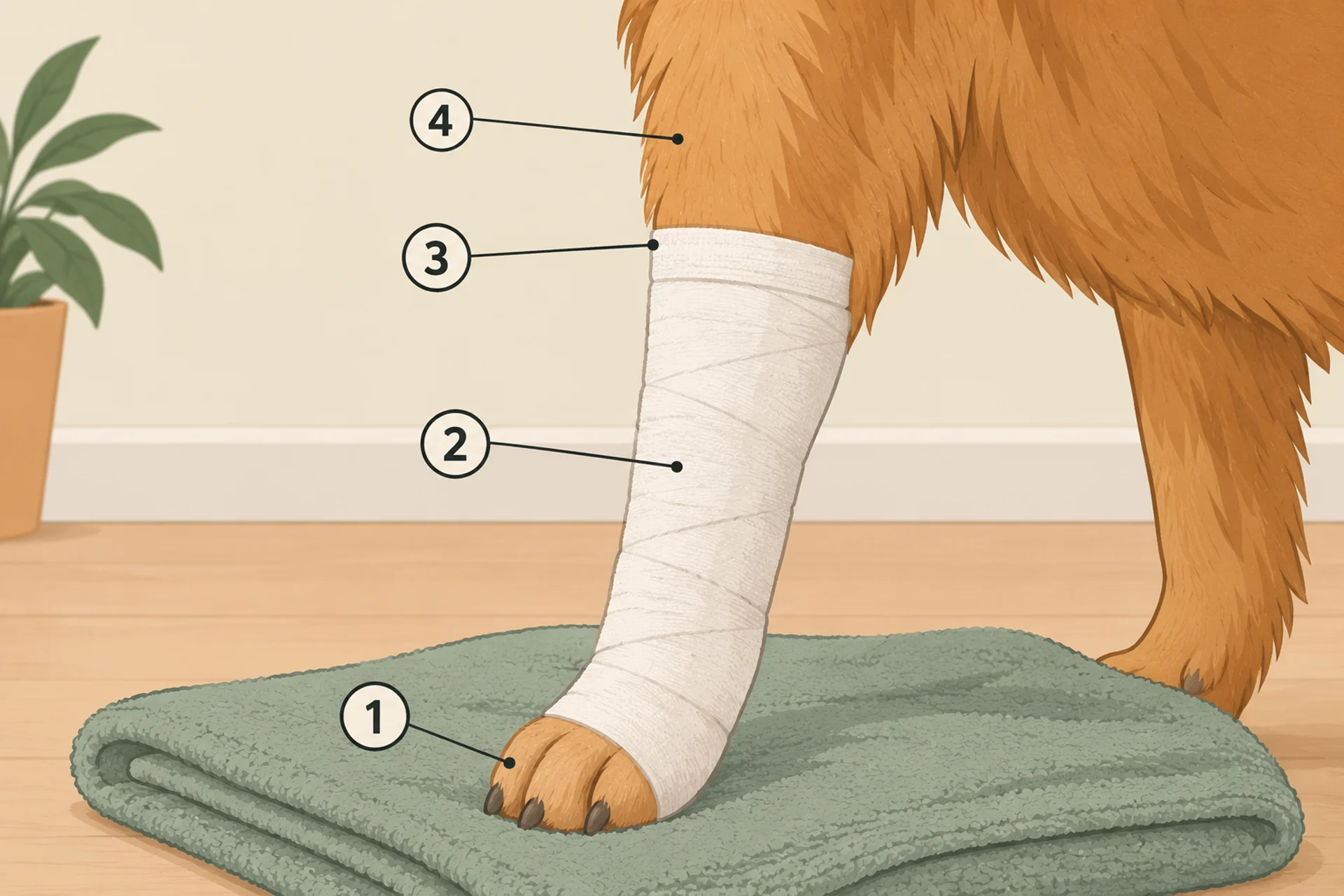
| Where to look | Call the clinic if you see |
|---|---|
| ① Toes | Swelling, discharge or a smell from the toes, or toes that feel a different temperature from the other foot (VCA). The ACVS also lists cold toes |
| ② Bandage surface | Any damp patch, or a bandage that is soiled or smells. VCA says to arrange a recheck as soon as possible if the bandage becomes wet or soiled |
| ③ Top edge | Slipping or bunching (ACVS) |
| ④ Above the bandage | Swelling or a colour change above or below the bandage, or your dog chewing at it (VCA) |
Stitches with no bandage
A spay or neuter incision, or stitches on the body, usually isn’t covered at all. That makes the rule simpler: the incision stays dry. VCA’s instruction is do not bathe your dog or allow the incision to get wet. The ASPCA’s post-surgery sheet explains one reason: surgical glue on the incision will dissolve too quickly if it becomes wet, so there’s no bathing for the ten-day recovery period. It also says to keep your pet indoors, clean, dry and warm, with leashed walks for bathroom purposes only.
So on a wet day, the plan is the same short trip as above, minus the bag:
- Pick the most sheltered spot you have. A patch under a tree, an overhang, the side of the house that takes less rain. Short and close beats a proper walk.
- Keep the leash short. No sniffing tour, no puddles, no rolling in wet grass. On a belly incision, a dog that lies down in wet grass undoes the whole plan.
- Keep the cone on if your vet gave you one. Licking is the other way an incision gets wet. VCA says an Elizabethan collar may be needed if your dog licks or chews the site.
- Look at the incision when you’re back in. VCA asks for at least two checks a day on an unbandaged incision.
What about a coat or a raincoat over the stitches? It’s a fair thought, and VCA does list a dog coat or a T-shirt among the ways to cover a wound, depending on where it is. But in that guidance the job is stopping your dog licking or chewing it, not keeping rain off. A raincoat over a fresh incision can also hold damp underneath if your dog gets wet anyway. Ask your vet before you put anything over stitches. If they’re happy with it, keep it loose, clean and dry, and take it off as soon as you’re inside, same as the bag.
If the bandage gets wet anyway
It happens. The bag splits, your dog steps in a deep puddle, someone forgot. The instinct is to dry it with a towel or a hair dryer and hope. Don’t rely on that. A bandage can feel dry on the surface while the padding against the skin stays wet, which is exactly the problem the AMC describes.
VCA’s instructions are to contact your veterinary clinic and schedule a recheck as soon as possible if the bandage becomes wet or soiled, or becomes smelly. The AMC’s line on smell is just as direct: if you detect a bad smell coming from the bandage, it should be removed and replaced immediately. That’s a job for the clinic, not for you at home, unless your vet has shown you how to change it.
For an unbandaged incision that got rained on, call and describe what happened. VCA’s list of reasons to call includes continued bleeding, seepage lasting more than 24 hours, swelling, excessive redness, a bad smell, discharge, or stitches your dog has pulled out.
How long does all this last?
Until your vet says it’s over, which is not the answer anyone wants in a week of rain, but it’s the honest one. For incisions, VCA says non-dissolving stitches or staples are usually removed 10 to 14 days after surgery, with activity restricted for 7 to 14 days. The ACVS says bathing and swimming should wait until healing is complete and you’ve been given clearance. Bandages run on whatever schedule your vet set at the last change.
Once your dog is cleared, rain goes back to being a comfort question rather than a medical one. For what actually matters on ordinary wet walks, see can dogs get sick from rain.
Before the next rainy trip out
- Keep a stack of heavy-duty bags and the tape by the door, so covering the bandage takes ten seconds.
- Cover on at the door, leash on, straight to the nearest grass, straight back.
- Cover off on the mat. Every time, even if the trip was two minutes.
- Check the toes, the surface, the top edge and the leg above.
- Damp, smelly or slipping: call the clinic. Don’t wait for it to dry.
- Stitches with no bandage: sheltered spot, short leash, cone on, check it when you’re back.
Can my dog go out in the rain with a bandage on?
Yes, for bathroom trips. Cover the bandage with a heavy-duty plastic bag or a protective bootie, keep your dog on a leash and with you, and keep the trip short. Take the cover off as soon as you’re back inside. Longer walks wait until your vet says your dog’s exercise restriction is over.
How long can I leave a plastic bag on my dog’s bandage?
Only while your dog is outside. The Animal Medical Center’s advice is to remove the bag or boot immediately when you come back indoors, because a bag left on makes the bandage soggy. It isn’t a waterproof layer to leave on all day.
My dog’s bandage got a little wet. Is that okay?
Treat it as a call to the clinic, not a wait-and-see. VCA says to arrange a recheck as soon as possible if a bandage becomes wet or soiled. Moisture held against the skin under a bandage can cause infection that you can’t see from outside.
Can I walk my dog in the rain after a spay or neuter?
Only for leashed bathroom breaks. The ASPCA’s after-surgery instructions are to keep your dog indoors, clean, dry and warm, and to walk on a leash for bathroom purposes only during recovery. The incision shouldn’t get wet, so pick a sheltered spot and keep the trip short.
Can I put a dog boot or raincoat over a bandage or stitches?
Only with your vet’s approval. The AMC mentions a waterproof boot for long-term bandages if your veterinarian approves. For stitches, a coat is sometimes used to stop licking, but it doesn’t guarantee the incision stays dry. Whatever you use, take it off as soon as you’re back inside.
How long do I need to keep my dog’s stitches dry?
Until your vet clears it. Non-dissolving stitches and staples are usually removed 10 to 14 days after surgery, and the ASPCA’s sheet says no bathing for the ten-day recovery period. Your vet’s instructions for your dog’s surgery come first.
Cover it for the trip, take it off at the door.
The bag is for the ten minutes outside. The check is for the minute after. If anything is damp, smelly or slipping, that’s the clinic’s job, today.
Sources
- VCA Animal Hospitals — Bandage and Splint Care for Dogs (checked 2026-10-06)
- VCA Animal Hospitals — First Aid for Torn or Injured Foot Pads in Dogs (checked 2026-10-06)
- VCA Animal Hospitals — Care of Surgical Incisions in Dogs (checked 2026-10-06)
- VCA Animal Hospitals — Care of Open Wounds in Dogs (checked 2026-10-06)
- The Animal Medical Center (New York) — How to Care for Your Pet’s Bandage (checked 2026-10-06)
- American College of Veterinary Surgeons — Postoperative Care After Surgery: What Animal Owners Should Expect (checked 2026-10-06)
- ASPCA Spay/Neuter Alliance — After Surgery: How to Care for Your Pet (checked 2026-10-06)
This guide is general information, not veterinary advice. Your veterinarian’s discharge instructions for your dog take priority over anything here, and any wet, smelly, slipping or swollen bandage is a call to the clinic.