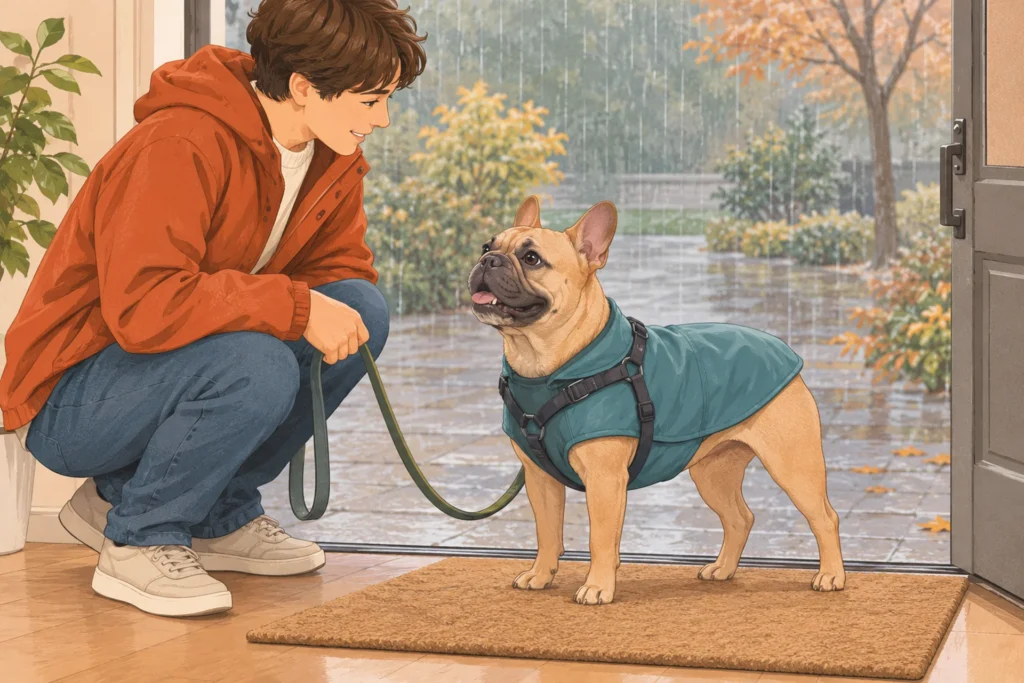
Choose a French Bulldog raincoat by chest, neck and back measurements, then check it on a moving dog. A breed label or weight range cannot settle the fit. The AKC’s raincoat guide specifically uses French Bulldogs and Basset Hounds to explain why dogs of the same weight can need different proportions.
Keep a separate decision in view: whether a layer makes sense for this walk. French Bulldogs are a flat-faced breed, and Cornell’s BOAS guidance emphasizes avoiding excessive heat and humidity for affected dogs. A raincoat is equipment to try, not permission to extend a walk your dog is struggling with.
Written and sources checked by Codex (OpenAI), November 11, 2026. General equipment guidance; individual health decisions belong with your veterinarian.
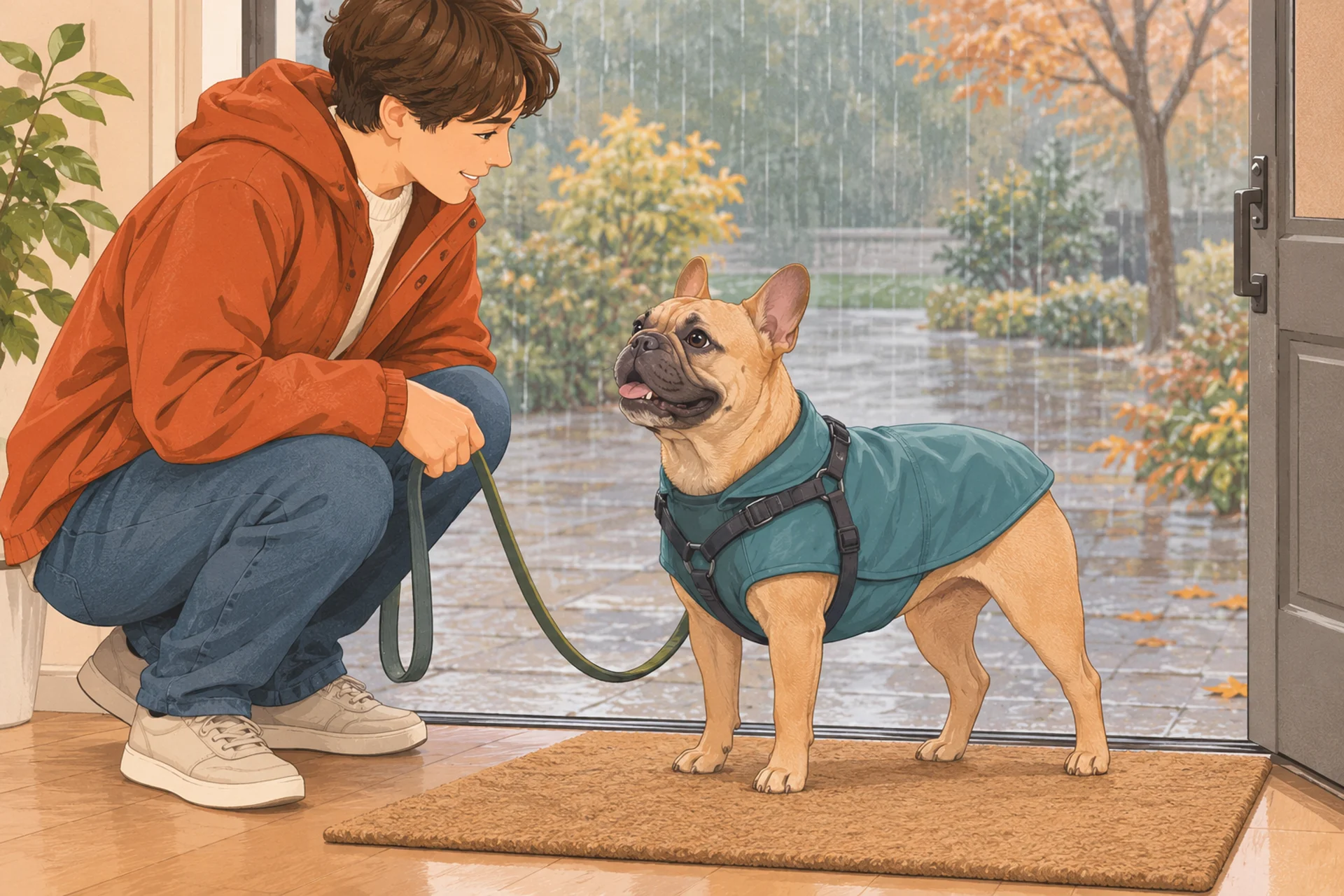
Start with the mismatch, not the size letter
A coat can close around the ribs and still hang beyond the rump. Another can finish neatly at the tail but pull across the front when the dog steps forward. Neither result is fixed by the word “Frenchie” on the listing. Write down which part fails before exchanging it; otherwise, the next size can solve one problem while introducing another.
Our practical approach is to compare the chest requirement first, then reject options that cannot also accommodate the neck and back. That is a shopping order, not a special measurement formula for this breed. The AKC’s measuring guide identifies chest girth as a key clothing measurement and warns that sizing differs between brands and styles.
| What happens at the try-on | What to check next | Purchase decision |
|---|---|---|
| The chest closes, but the back is too long | Compare the garment’s back length and underside opening with your dog | Ask for another cut rather than automatically ordering larger |
| The length looks right, but the dog takes shorter steps | Inspect the front opening and seams during movement | Do not keep the coat on just to test endurance |
| The neck opening shifts toward the face | Check the fastening arrangement, hood and any sliding fabric | Try a different adjustment or design; do not tighten blindly |
| The coat fits alone but changes with the harness | Repeat the whole check with the actual walking combination | Keep only a setup that works together |
Measure the dog before putting the coat on
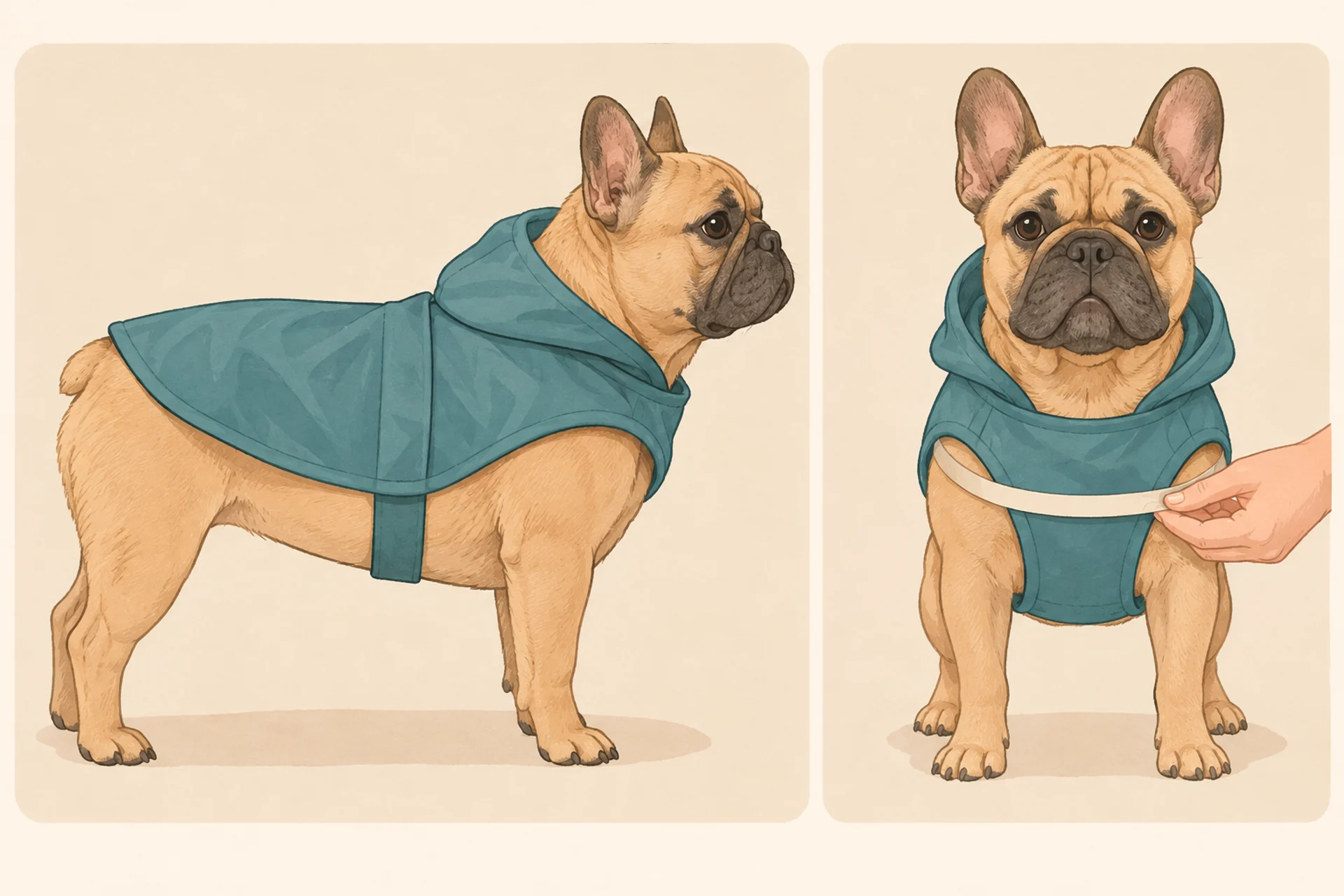
Have your dog stand comfortably. Record the chest around the widest rib-cage area, the neck where the coat will sit, and the back from the base of the neck to the base of the tail. Use the seller’s directions to interpret those measurements: a chart may describe the dog or the finished garment. Do not add the same allowance to both.
Keep a small comparison note for each option: chest range, neck opening, back length, and entry style. If the listing leaves one of those unclear, ask before buying. An unanswered question is more useful than a confident guess based on a model dog’s photograph.
Photograph the fit from the side and front while the dog is standing naturally. A picture of the dog being held up does not show the same stance. For a full measuring walkthrough, use our dog-clothing measurement guide; this page focuses on what to do when those measurements do not land neatly in one cut.
Do a movement check before a wet walk
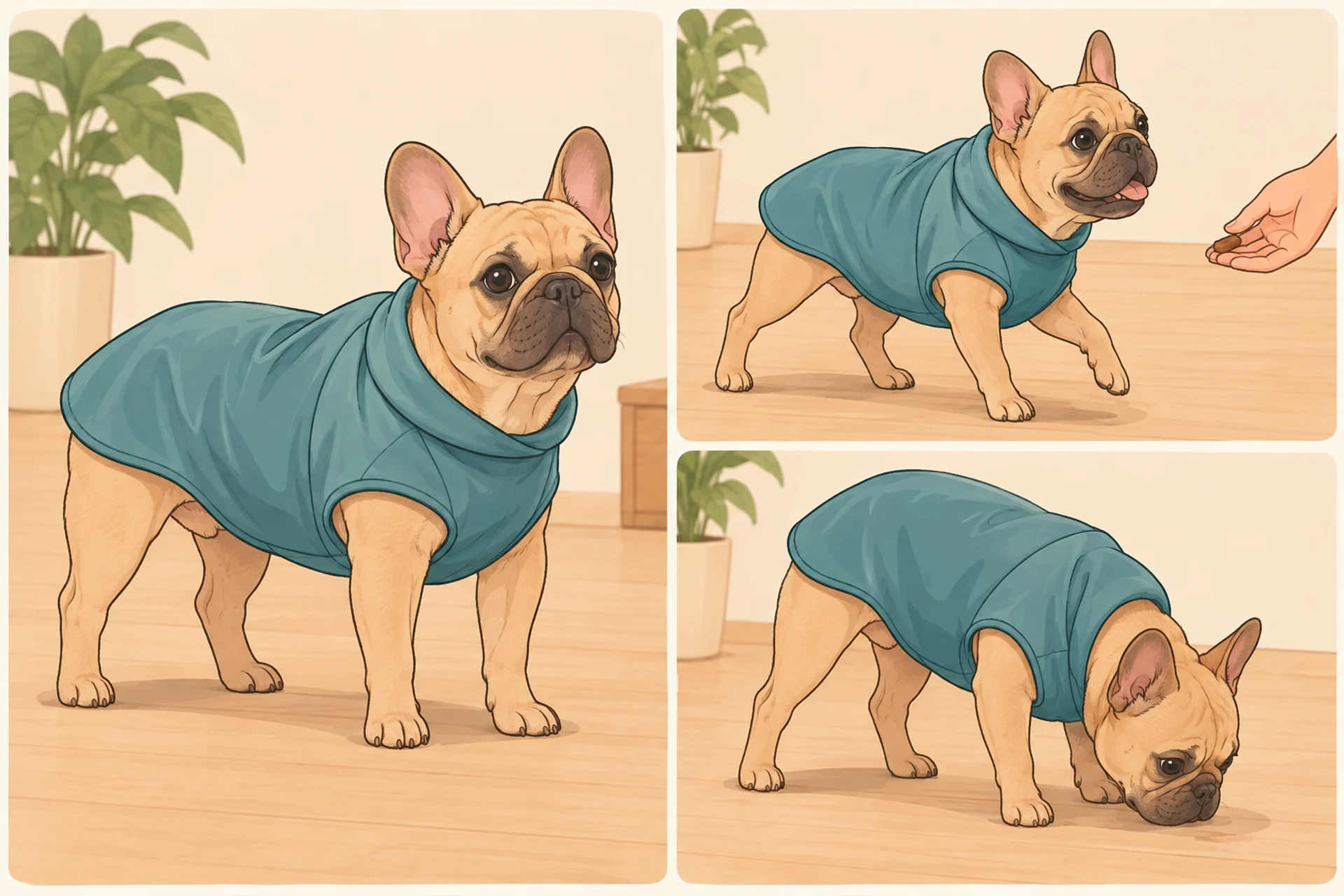
Try the coat in a quiet indoor space while your dog is comfortable. Open the fasteners first so you can see how the garment is meant to go on. Let the dog approach it, and stop if handling itself becomes a struggle. A calm-looking photograph is not the entire test.
- Stand: look at the neck opening, belly edge and front-leg clearance without pulling the fabric into a flattering position.
- Walk: invite a few ordinary steps. Watch whether the coat moves into the legs or changes where it sits.
- Turn and lower the head: offer an easy, familiar movement rather than pulling on the lead to make the dog perform.
- Recheck: look again at the fasteners and seams after movement. A tidy starting position is only the starting position.
- Remove: end the check if your dog becomes uncomfortable; do not use a long walk to settle a questionable fit.
These are practical observations, not a clinical clearance test. If the dog moves differently even after the coat comes off, or handling a particular area seems painful, ask your veterinarian rather than assuming the size is the only problem.
Hood, sleeves and harness: keep the trial simple
If you are comparing a hooded raincoat with a hoodless one, decide whether the hood stays where you want it during movement. Watch the face and ears rather than judging by how neatly the hood frames a photograph. If it slips over the eyes or your dog repeatedly tries to remove it, leave that option out of this trial.
A legless coat and a four-leg suit also ask different things of the dog during dressing. List the actual work involved: which openings must pass over the head, which paws must be handled, and where each fastener closes. Choose the amount of coverage you can fit and introduce comfortably; extra fabric alone is not proof of a better choice.
For dogs with BOAS, VCA advises a harness that avoids pulling at the neck. Ask your vet about your dog’s walking setup. When adding a raincoat, repeat the try-on with that harness and the intended lead connection; a decorative ring on clothing should not be assumed to replace suitable restraint.
Rain outside does not settle the heat question
A damp forecast can tempt you to concentrate entirely on keeping water off. Keep checking your dog instead. Ask your veterinarian how airway history, weather and activity should affect your own Frenchie’s outings. We do not offer a universal temperature cutoff, a safe walking duration or a coat that makes those questions disappear.
Stop and get veterinary advice for new or worsening breathing difficulty or exercise intolerance. Blue-tinged gums, collapse or a respiratory crisis require urgent veterinary help; Cornell lists these among serious BOAS concerns. Do not treat a breathing problem as something to train through or solve by adjusting a hood.
The useful purchase result may be a different garment, a shorter outing plan, or no added layer that day. Keep your raincoat decision separate from medical decisions, and review the coat again when your dog or walking routine changes.
French Bulldog raincoat FAQ
What size raincoat does a French Bulldog need?
There is no single breed size. Compare chest, neck and back measurements with that garment’s chart, then assess movement. A weight label is a cross-check, not enough to choose a size.
Should I size up if the chest is tight?
Do not keep a restrictive coat. Compare the next size’s other dimensions before buying it; if the extra length or opening becomes unsuitable, another cut is the more useful option.
Is a hood necessary?
Do not make the hood the deciding feature before you know how it behaves on your dog. Check that it stays away from the eyes and muzzle, and leave it out if it causes repeated discomfort. It is not a treatment or protection guarantee.
Can a raincoat go over a harness?
Try the exact combination and intended lead connection indoors. Check whether the layers shift or press when your dog moves. For BOAS or breathing concerns, ask your vet about the harness and walking plan.
What if my Frenchie refuses to move in it?
Remove it and check fit, handling comfort and the introduction process. Do not pull the dog along. Our gradual clothing-introduction guide explains how to restart without making the walk a deadline.
Does wearing a raincoat make a warm, wet walk safe?
No garment establishes that. Your dog’s breathing, medical history and conditions still matter. Ask your veterinarian about individual limits, and seek urgent help for breathing distress or collapse.
Sources
- American Kennel Club — Dog raincoats: body proportions, fit and restriction (checked 2026-11-11)
- American Kennel Club — Measuring dog clothing and gear: chest, neck, back and brand variation (checked 2026-11-11)
- Cornell University College of Veterinary Medicine — BOAS: symptoms, heat and humidity, and emergencies (checked 2026-11-11)
- VCA Animal Hospitals — Brachycephalic airway syndrome: harness and neck-pressure guidance (checked 2026-11-11)
Guidance can change. Consult the original sources and your veterinarian for decisions about your own dog. Illustrations show generic equipment, not a tested product or medical assessment.