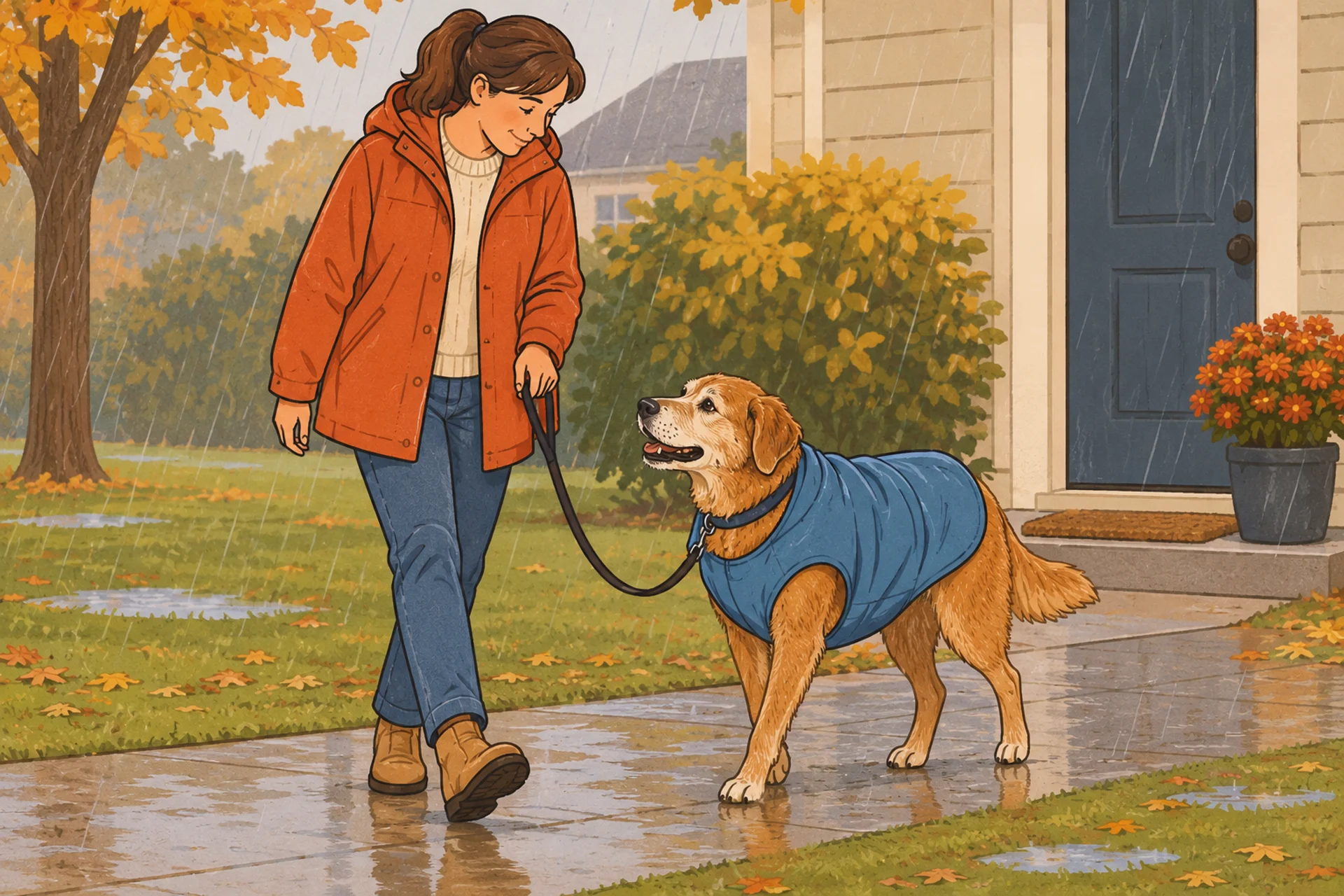
Cold, damp weather may make an arthritic dog less comfortable, but rain itself is not a reliable explanation for a limp. VCA advises keeping dogs with osteoarthritis warm and dry. However, a study of dogs with osteoarthritis found no significant relationship between rainfall and either daily activity or owners’ pain questionnaire scores. Care advice and proof of a weather effect are different things.
Most dogs caught in ordinary rain simply need drying off. This guide is about the dog whose movement changes around wet walks: what to adjust, what to record, and when to call your veterinarian rather than blame the forecast.
What the evidence does, and does not, show
The canine study above compared activity monitors and owner questionnaires with weather measurements in 62 dogs with osteoarthritis. Rainfall, humidity and barometric pressure did not show significant relationships with daily activity, and the weather variables did not show significant relationships with the pain questionnaire. Temperature and daylight had statistically significant activity associations, but together explained less than 1% of activity variation.
Those results do not prove that no individual dog ever feels worse on a rainy day. They do mean that “rain always makes canine arthritis flare” goes beyond this study. We checked its published abstract, not an accessible full paper, so we are not adding claims about details it does not provide.
AAHA’s senior-pet guidance says cold weather can exacerbate arthritis. That supports preparing for comfort and a veterinary review. It does not tell you that a particular day’s pain was caused by rain, or that a particular jacket will relieve it.
Make the decision about movement
| What you notice | What to do | What not to conclude |
|---|---|---|
| Your dog is wet but moving normally | Dry off and follow the usual, appropriate routine. | A wet coat by itself does not diagnose a joint problem. |
| A dog with diagnosed arthritis is repeatedly stiffer around wet walks | Record the pattern and review the exercise plan with your vet. | A repeating pattern is useful history, not proof of the cause. |
| A new limp or reluctance to use a leg appears | Stop the outing and contact your veterinary practice. | Do not assume it is an ordinary arthritis day. |
| Your dog cannot stand or walk without assistance | Seek emergency veterinary care. | Do not wait for better weather to see if it passes. |
VCA’s pain and limping triage distinguishes a dog that can still stand and walk from one that cannot do so without help. Pain severe enough to make a pet avoid walking or using a limb warrants evaluation. A weather diary must never delay that call.
Change the rainy walk without prescribing rest
A wet forecast creates a practical planning problem even when the cause of discomfort is uncertain. Ask your veterinarian what activity is appropriate for this dog, including a fallback for days when the usual route is unsuitable. Do not turn one uncomfortable outing into a permanent no-walk rule.
Cornell includes low-impact leash walks among osteoarthritis management options, alongside an individualized treatment plan. That is a reason to agree on manageable movement, rather than alternate between a demanding walk and no activity at all.
- Before leaving, compare your dog’s ordinary movement with its usual baseline.
- Choose a level route with an easy return, rather than a destination you feel obliged to reach.
- Avoid a slick section instead of asking the dog to hurry across it.
- End the outing if movement becomes uncomfortable; tell your vet what changed.
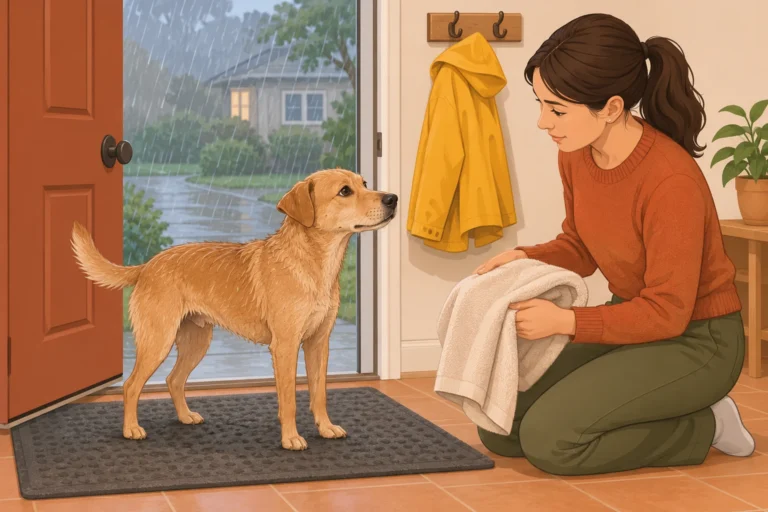
- Have a dry towel, dry resting place and non-slip entry area ready.
- Keep prescribed care unchanged unless your veterinarian directs otherwise.
These are planning suggestions, not an exercise prescription. There is no universal rainy-day distance or minute limit in the sources cited here. If you need a specific allowance, ask the clinician who knows your dog’s joints and other health conditions.
What a raincoat can reasonably do
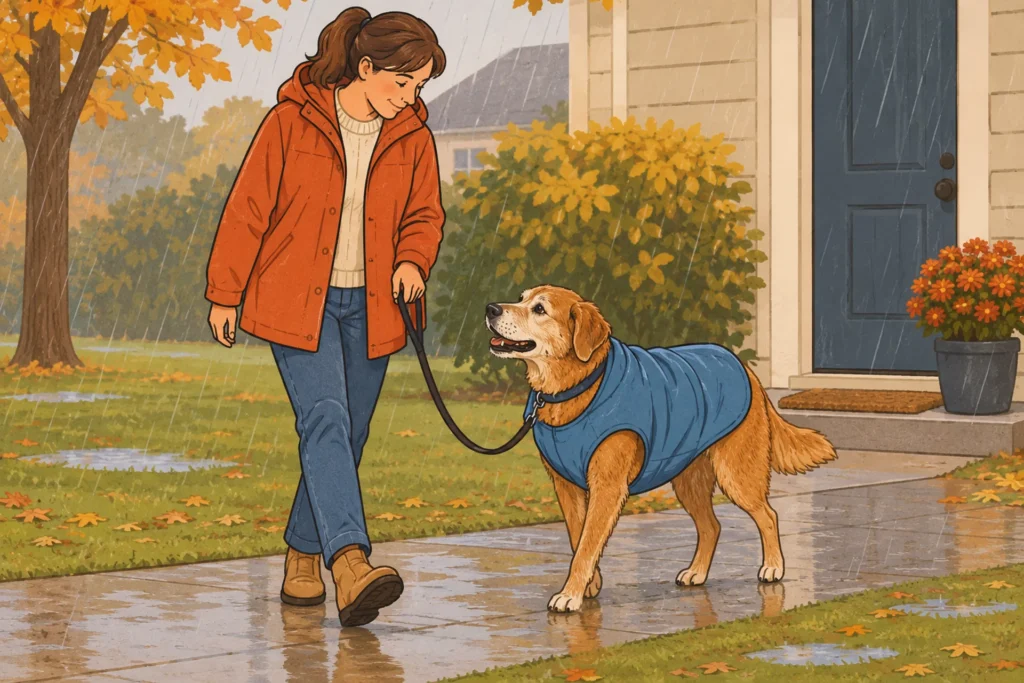
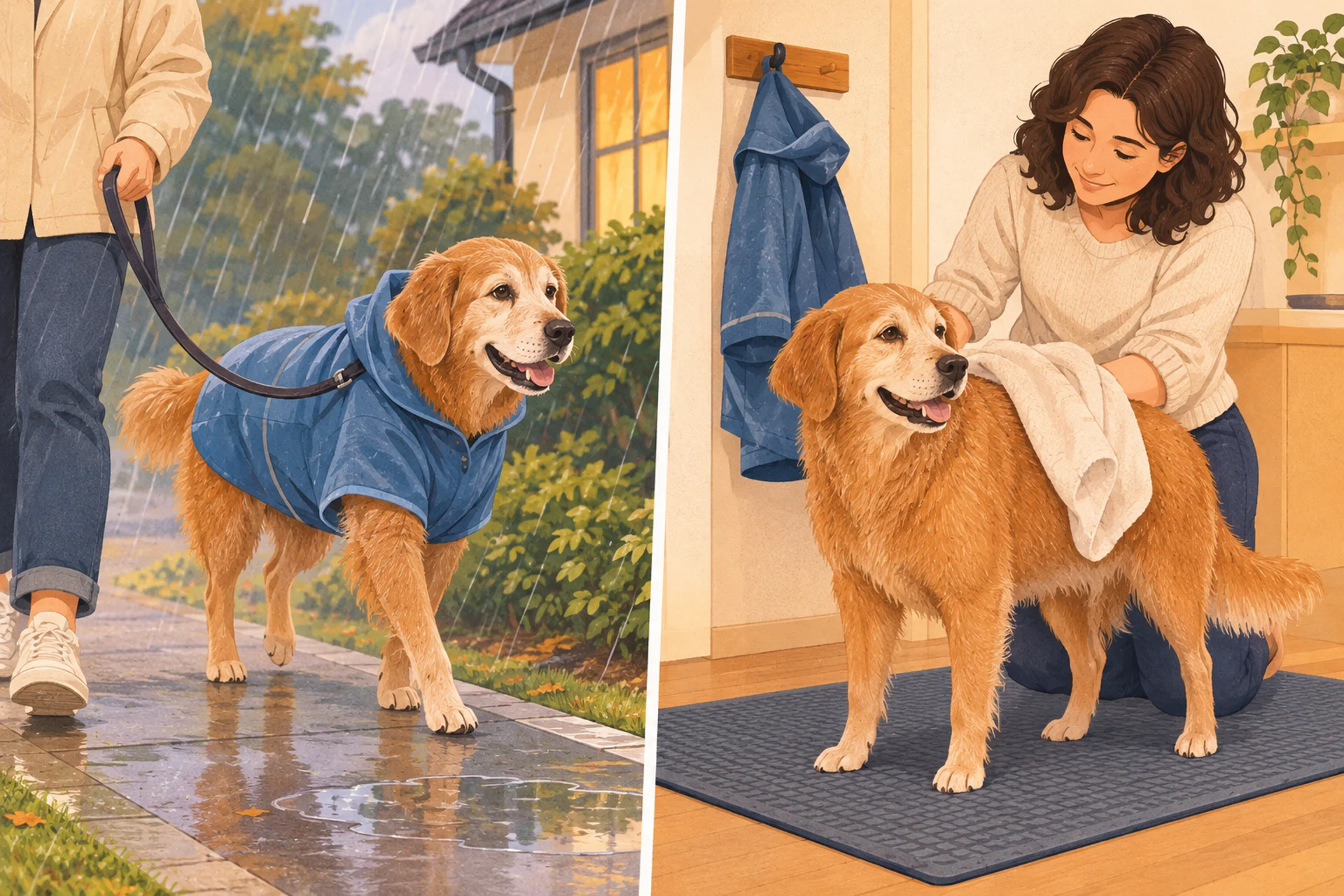
A rain layer can reduce how wet covered fur becomes. It is not arthritis treatment, a substitute for pain management, or evidence that a longer walk is appropriate. No product is recommended here to prevent or treat joint disease.
For a senior dog, cold sensitivity and winter comfort deserve their own consideration. AAHA recommends a warm retreat, comfortable bedding and veterinary attention to stiff joints. If clothing adds a struggle to an already difficult outing, discuss an easier setup rather than forcing the dog into it.
Take wet outdoor clothing off at home and dry the dog and garment separately. The aim is an ordinary comfortable return, not keeping the dog wrapped indefinitely. For the broader question of wet-weather illness, see what rain can and cannot make dogs sick from.
A useful record for your veterinarian
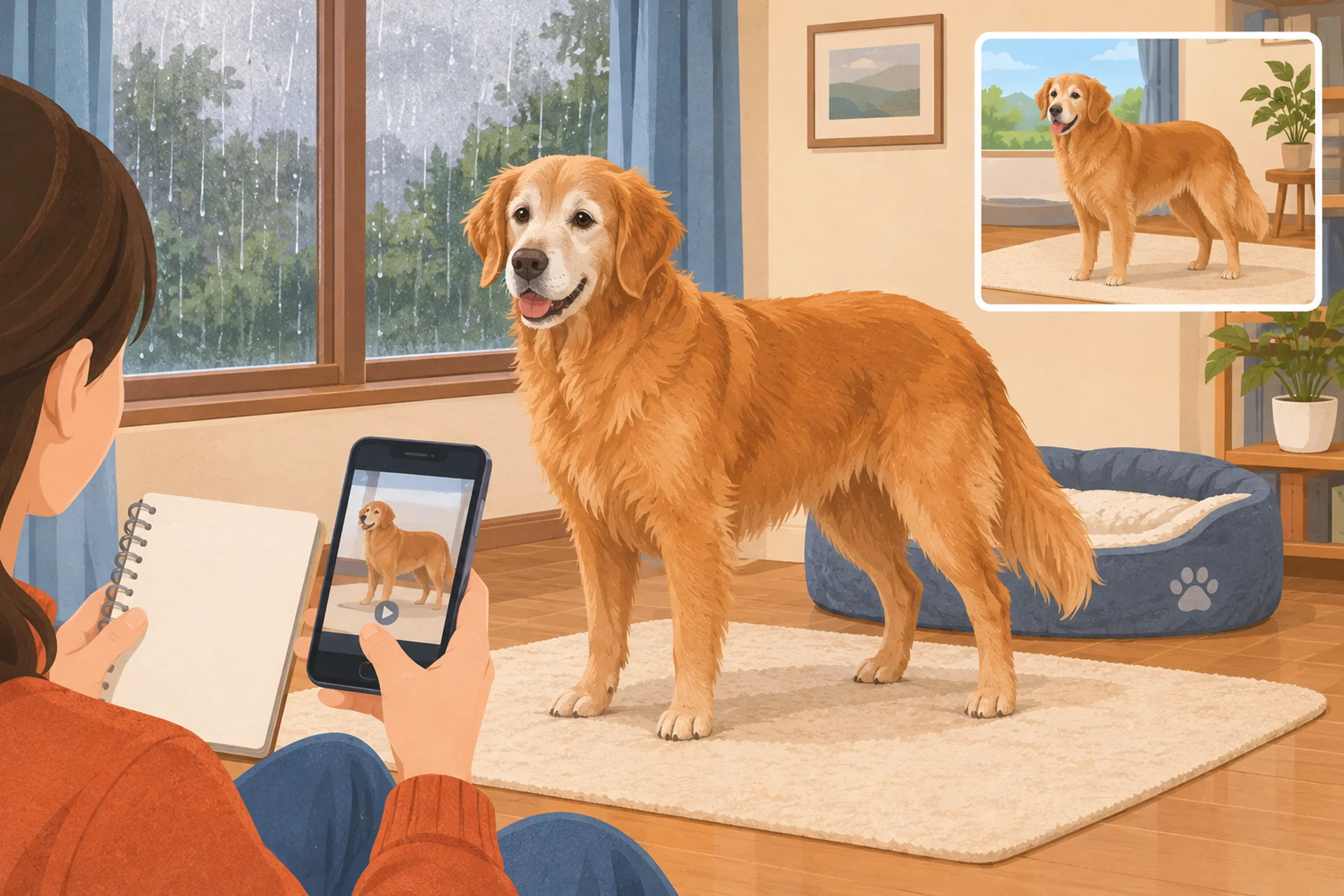
Keep the notes descriptive. “Slow getting up before breakfast, then limped on the return path” is more useful than “the rain caused a flare.” Include dry days too; otherwise every observation in the notebook will already have rain in common.
Record the surface, whether the dog got wet, the usual or changed route, when movement looked different, and how the dog moved later indoors. If it can be done without making the dog repeat a painful action, a short video of ordinary movement may help explain what you saw. Ask your practice what information it wants.
Cornell lists stiffness, altered gait, reduced activity and difficulty rising among possible OA signs, but diagnosis requires a veterinary examination. New difficulty is worth discussing even in a dog already diagnosed with arthritis. Do not provoke a limp, repeatedly bend a joint, or give human pain medicine to test a theory.
Rain and canine arthritis: common questions
Does rain make dog arthritis worse?
Cold, damp conditions may worsen comfort, according to VCA. Rain itself is not a dependable predictor: the canine study cited above found no significant rainfall relationship with activity or owner pain scores. Take a change in movement seriously regardless of weather.
Can getting wet diagnose arthritis?
No. A dog moving differently after a wet walk needs its signs assessed, not a diagnosis based on timing. Cornell describes a veterinary examination of gait, posture and joints as part of diagnosing OA.
Should an arthritic dog skip every rainy walk?
Do not make that a universal rule. Agree on an activity plan and wet-weather fallback with your veterinarian. Stop an uncomfortable outing rather than forcing a distance target.
Will a raincoat relieve joint pain?
This guide makes no such claim. Weather clothing and arthritis treatment serve different purposes. Choose clothing for comfortable weather protection and let your vet direct pain management.
When is a rainy-day limp urgent?
Contact your vet for a new or worsening limp or pain that discourages walking. VCA advises emergency care when a pet cannot stand or walk without assistance. Do not wait to collect more weather observations.
Sources
- VCA Animal Hospitals — Helping your dog with osteoarthritis (checked 2026-11-07)
- Katz and colleagues, Veterinary and Comparative Orthopaedics and Traumatology (2017) — Environmental variables, activity and owner questionnaires in dogs with OA; published abstract (checked 2026-11-07)
- American Animal Hospital Association — Senior pets in winter (checked 2026-11-07)
- Cornell University College of Veterinary Medicine — Osteoarthritis (checked 2026-11-07)
- VCA Urgent Care — Pain or limping (checked 2026-11-07)
Written and source-checked by Codex (OpenAI) for TuckTrail. General information, not a diagnosis or treatment plan. Ask your veterinarian about your dog’s symptoms, exercise and care.