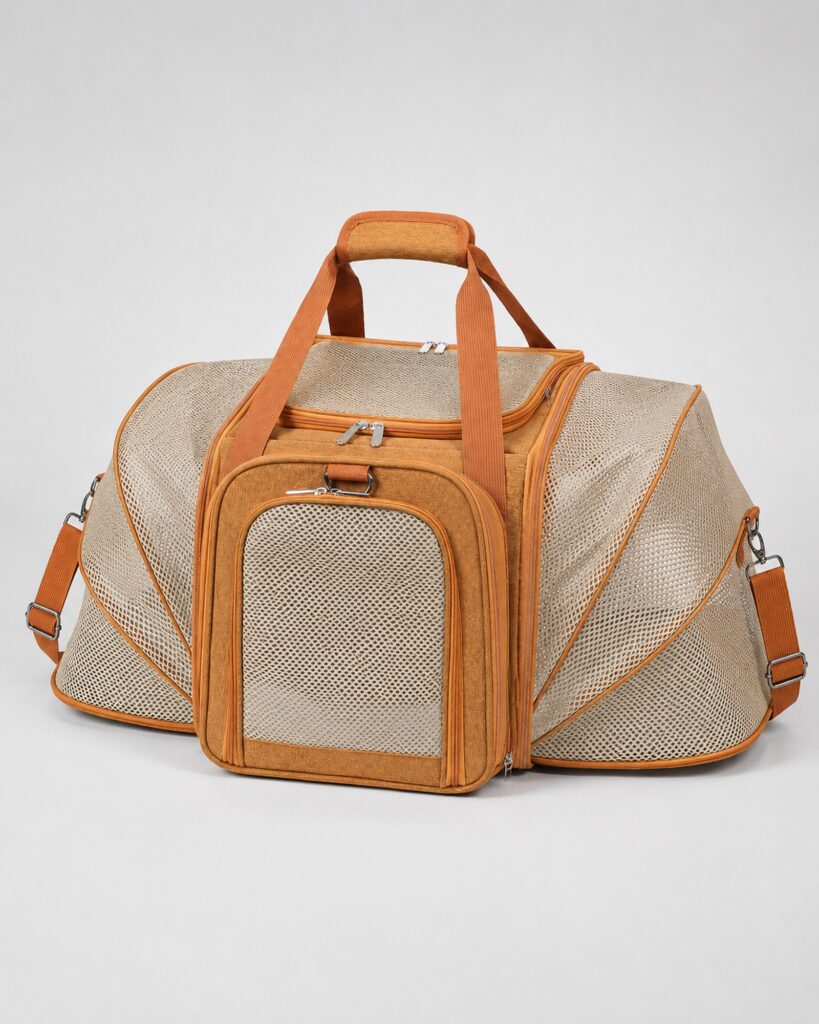
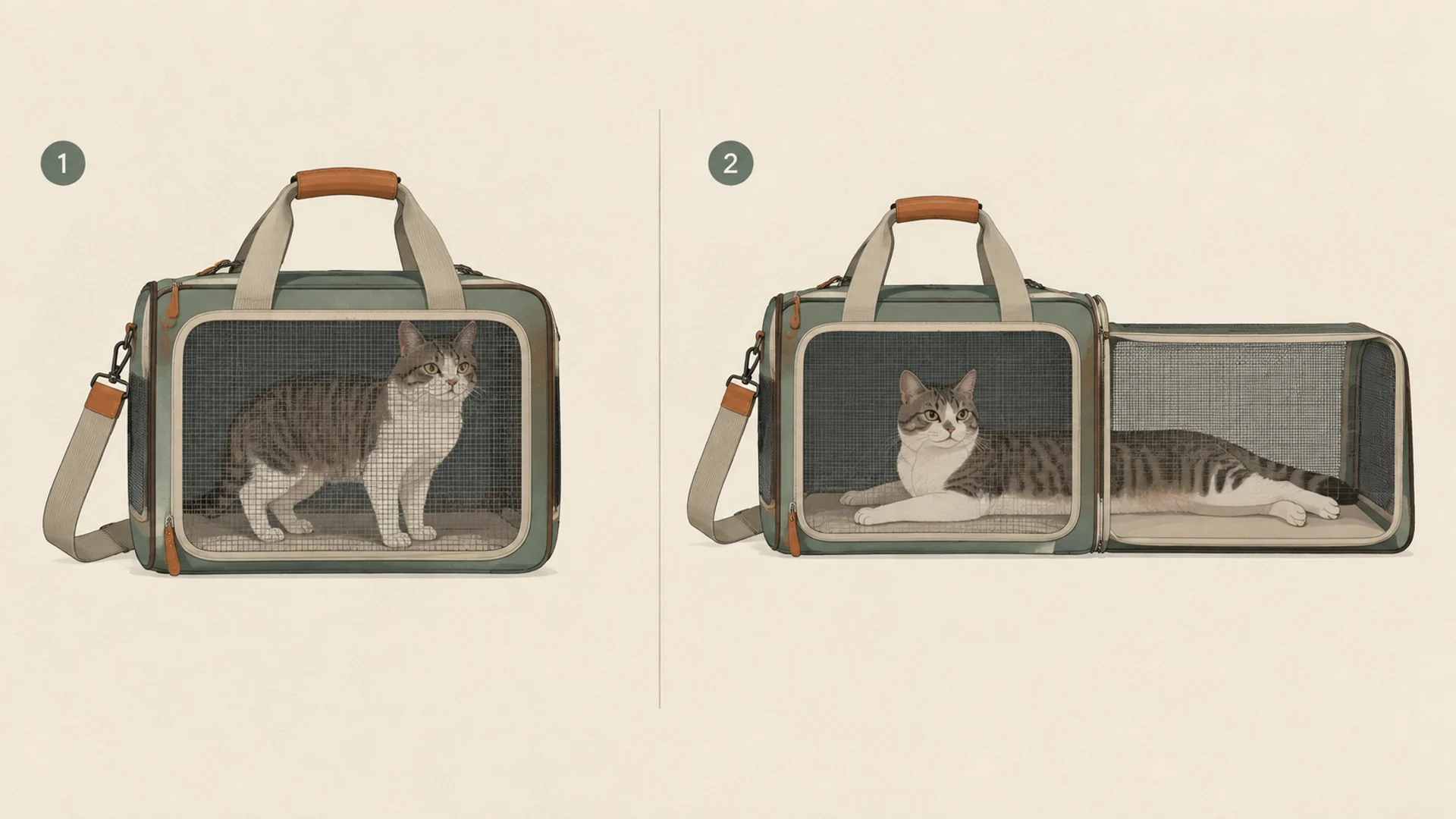
An expandable pet carrier is a compact bag with a bonus room, not a bigger bag in disguise. Size it by the zipped dimensions — that is the shape that has to satisfy an under-seat space, a train’s carrier limit, or a cabin sizer — and treat the zip-out pods as stretch space for the waiting, not as extra capacity for a larger pet.
The test that actually matters is the same one the veterinary and airline bodies all publish, and it applies to the closed bag: your pet should be able to stand without touching the top, sit up, turn around, and lie down comfortably. If they only pass that test with the pods open, the carrier is too small.
How the expansion actually works
Most expandable carriers add one or two zip-out mesh pods on the sides or back. Unzipped, the pod roughly doubles the usable floor area, letting a pet stretch out instead of staying curled. The pod walls are mesh with light framing — comfortable for resting, not structural for carrying. That distinction drives every rule below.
What “big enough” actually means — and why it applies zipped
Three separate bodies publish a size test for pet travel containers, and they say almost exactly the same thing in slightly different words. The American Veterinary Medical Association asks for a crate “large enough to allow the pet to stand (without touching the top of the cage), sit up, turn around, and lie down comfortably,” and adds that short-nosed breeds need one size larger than normal. IATA’s container requirements use the phrasing “turn about normally while standing, to stand and sit erect, and to lie in a natural position.” The ASPCA puts it as “large enough for your pet to stand, sit, lie down and turn around in.”
Four verbs, three organisations, no disagreement. The useful part for an expandable bag is what none of those definitions mention: a temporary annexe. The standard describes the enclosure your pet travels in, and on a plane, a train or a walk between gates, that enclosure is the zipped shape. Run the four-verb test with the pods closed. If it fails there, the pods are compensating for a carrier that is one size too small, and every moment your pet is actually in transit is the moment they will not help.
When the expansion helps — and when it must close
| Moment | Expanded? | Why |
|---|---|---|
| Airport waits and layovers | Yes | Floor space during long sits, away from foot traffic |
| In flight, under the seat | No | Under-seat space fits the zipped dimensions only |
| On a train, under your seat | No | Rail carrier limits are published as fixed dimensions |
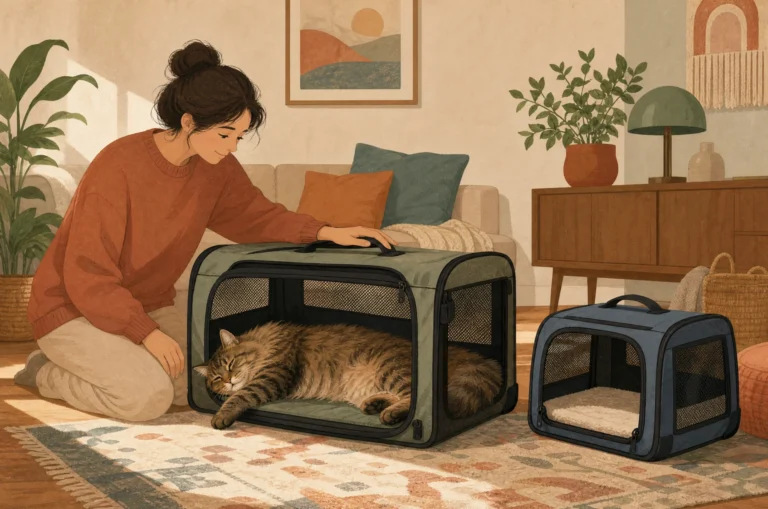
| Hotel rooms and visits | Yes | Instant familiar den while the room stays new |
| Carrying between places | No | Pods are for resting, not for load-bearing transit |
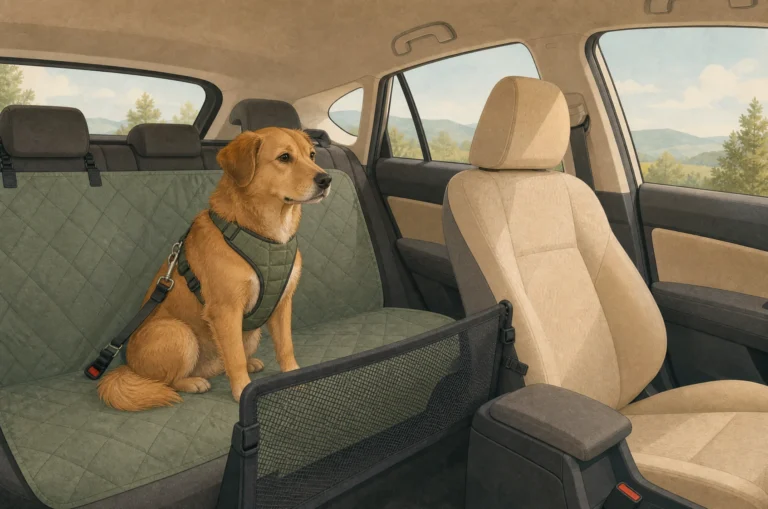
| Car rides | Usually no | A seat-belted carrier should present its compact, stable shape |
Sizing an expandable carrier: zip it first
Shop by the zipped dimensions, because that is the shape that has to fit under a seat or a cabin sizer. Treat the expansion as a bonus for the waiting room, not as extra size allowance for a bigger pet. If your pet only fits when the pods are open, the carrier is too small — full stop. Our sizing guide covers how to measure your pet against listed dimensions.
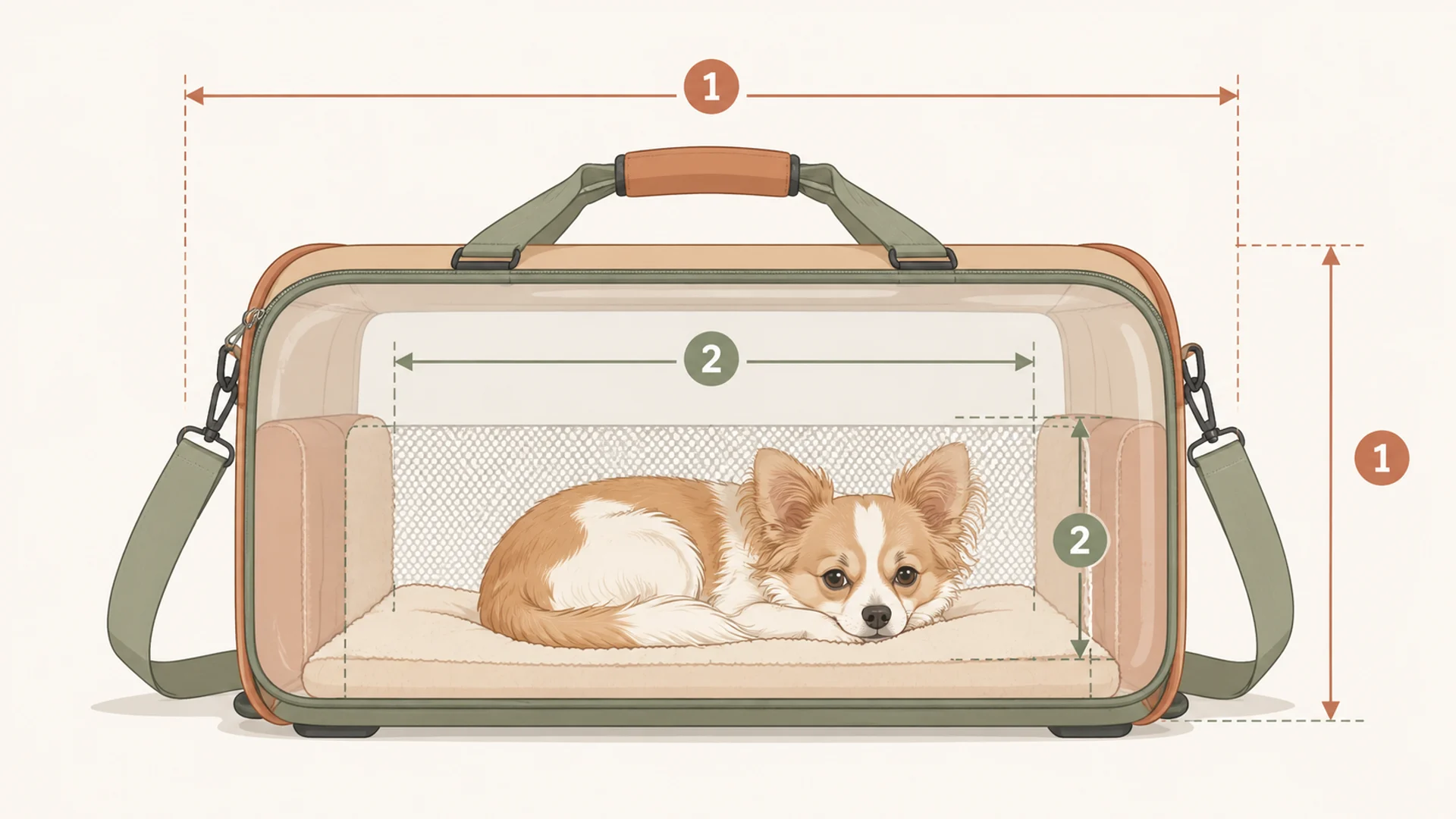
One trap catches people out on every carrier, expandable or not: the numbers on the box are the outside of the bag. Padded walls, a stiffened base and the frame all sit inside that figure, so the space your pet actually gets is smaller — sometimes by two inches or more in each direction. Measure your pet against the interior, and if a listing only publishes exterior dimensions, ask before you buy.
The gates that measure the zipped shape
Cabin under-seat space is the gate people plan for, and it is the vaguest one — it varies by aircraft and airlines publish a guideline rather than a guarantee. Ground transport is the opposite: the numbers are exact and published in advance. Amtrak caps pet carriers at 19 inches long by 14 wide by 10.5 high and requires the pet and carrier together to weigh no more than 20 pounds. VIA Rail in Canada caps the carrier at 55 by 40 by 27 centimetres and the combined weight at 10 kilograms.
None of those limits have a clause for a bag that can be made smaller. What gets measured is the carrier you are carrying, so the practical rule holds everywhere: an expandable carrier is only as large as its zipped envelope, and the height figure is usually the one that fails first. Our guide to taking a dog on a train or bus works through the rest of those limits, and the under-seat size guide covers the cabin side.
“Airline approved” is not something anyone issues
Expandable carriers are marketed with the phrase constantly, so it is worth being precise: IATA publishes container requirements that airlines enforce, but it does not approve or certify individual containers, and no sticker on a listing means an airline has signed off on that bag. What exists is a set of requirements — the four-verb size test, ventilation, secure fastening — plus each airline’s own published dimensions. A carrier either meets the airline you are flying or it does not, and the only way to know is to compare your zipped numbers with that airline’s current page on the day you book.
Where an expandable bag actually fails
The AVMA’s travel brochure contains a sentence worth reading twice: “Defective crates or carriers are the most common cause of escaped or injured animals during air travel.” It is written about cargo-hold crates, but it points at the right component for a soft bag too. On an expandable carrier, the pods are opened and closed far more often than the main door — every airport wait, every hotel room, every vet visit — so the pod zippers accumulate cycles faster than anything else on the bag. Judge a model by those zippers and by whether the expanded floor sits flat instead of sagging under your pet’s weight, not by how impressive the expanded footprint looks in the listing photograph.
Ventilation is the other place to look, and the published standard again describes cargo crates rather than cabin bags: the AVMA lists adequate ventilation on at least three sides for domestic flights and four for international. A soft carrier with mesh panels usually clears that comfortably, but check the closed bag rather than the open one. A carrier whose airflow depends on the pods being unzipped has its ventilation in the wrong place.
Getting your pet used to it before the trip
An expandable carrier asks slightly more of a pet than a plain one, because the shape changes around them. Both the AVMA and the ASPCA give the same preparation advice, and it is worth following early: take time to let your pet get used to the carrier before travel, and for car journeys build up with a series of short drives, gradually lengthening the time spent in the vehicle. Practise the zip too. You will be opening and closing the pods in cramped gate areas with a queue behind you, and a pet who has heard that zipper a hundred times at home will not react to it on the day.
TuckTrail picks
The Sky Double-Expand Mesh Pet Travel Carrier lists 18.1 x 11 x 11 in zipped and is rated for pets up to 15.4 lb. For smaller companions, the Sky Compact Expandable Mesh Pet Carrier runs 13.8 x 11 x 9.4 in and is rated to 11 lb. Both keep the expansion in mesh pods that zip flush for transit — compare zipped dimensions with your airline’s or operator’s current published limits before travel day.
What to check before buying
- The four-verb test, pods closed: stand without touching the top, sit up, turn around, lie down comfortably.
- Zipped dimensions vs the limits you will actually meet: your airline’s under-seat guideline, and the fixed numbers published by any rail operator on your route.
- Interior, not exterior: padded walls and a stiffened base can take two inches or more in each direction.
- Pod floor support: the expanded floor should sit flat, not sag under your pet’s weight.
- Zipper quality on the pods: pods open and close far more often than the main door.
- Ventilation with the bag closed: airflow should not depend on a pod being unzipped.
- Weight rating, and whether your limit counts the bag: Amtrak’s 20 lb and VIA’s 10 kg both include the carrier. Expansion adds floor space, never carrying capacity.
- Setup speed: practise the zip at home before you need it in a gate area.
Expandable carrier FAQ
Can the carrier stay expanded under an airplane seat?
No — plan around the zipped dimensions for the entire time the carrier is under the seat. The expansion is for the terminal, the layover, and the hotel, not the cabin floor.
Does the expansion make the carrier fit a bigger pet?
No. Size to the zipped interior and the stated weight rating. The four-verb standard that the AVMA, IATA and ASPCA all publish describes the enclosure your pet travels in, and in transit that is the closed bag. The pods give a correctly-sized pet room to stretch during waits; they do not upgrade the carrier’s capacity.
Are expandable carriers less sturdy?
The main compartment carries like any soft-sided bag; the pods are the light part. Judge sturdiness by the core bag’s base, frame, and zippers, and treat the pods as resting space only. The pod zippers are the component that sees the most cycles, so they are where wear shows first.
Is an expandable carrier “airline approved”?
No carrier is, in the sense the phrase implies. IATA publishes container requirements but does not approve or certify individual containers, and each airline sets its own under-seat dimensions. Compare your carrier’s zipped numbers against your specific airline’s current published limits.
Can I use an expandable carrier on a train?
Yes, if the zipped shape fits. Amtrak’s limit is 19 x 14 x 10.5 inches with a 20-pound cap on pet and carrier together; VIA Rail’s is 55 x 40 x 27 cm with a 10-kilogram combined cap. Neither makes an allowance for a bag that folds down, so measure it closed.
Should my pet sleep in the expanded pod overnight?
A hotel room is exactly the moment the expansion earns its keep — it gives a familiar den in an unfamiliar room. Set it on the floor rather than a bed, keep it away from the door, and follow the same preparation advice as for the trip itself: a carrier your pet already knows is far less stressful than one they meet for the first time at 11 pm.
Bottom line
An expandable carrier is a compact bag with a bonus room. Size it zipped against the four-verb test, check the zipped envelope against whichever operator you are travelling with, and expand it during the waits — and it becomes one of the most practical shapes in soft-sided travel, especially on the long airport days where a little extra stretch room changes your pet’s whole trip.
Sources
- American Veterinary Medical Association — Traveling With Your Pet (crate large enough to stand without touching the top, sit up, turn around and lie down comfortably; short-nosed breeds one size larger; ventilation on at least three sides domestic and four international; “defective crates or carriers are the most common cause of escaped or injured animals during air travel”; acclimating a pet to the carrier before travel) (checked 2026-09-07)
- IATA — Traveling with Pets (container must allow the animal to “turn about normally while standing, to stand and sit erect, and to lie in a natural position”; IATA does not approve or certify containers) (checked 2026-09-07)
- ASPCA — Travel Safety Tips (carrier “large enough for your pet to stand, sit, lie down and turn around in”; acclimate with a series of short drives, gradually lengthening time spent in the car) (checked 2026-09-07)
- Amtrak — Traveling with Pets (maximum carrier 19 × 14 × 10.5 in; 20 lb combined weight of pet and carrier) (checked 2026-09-07)
Airline, rail and transit carrier limits change without notice, and the container standards above are written for air travel. Confirm the current published dimensions with your own operator before you travel, and talk to your veterinarian about whether the trip and the container suit your own animal.