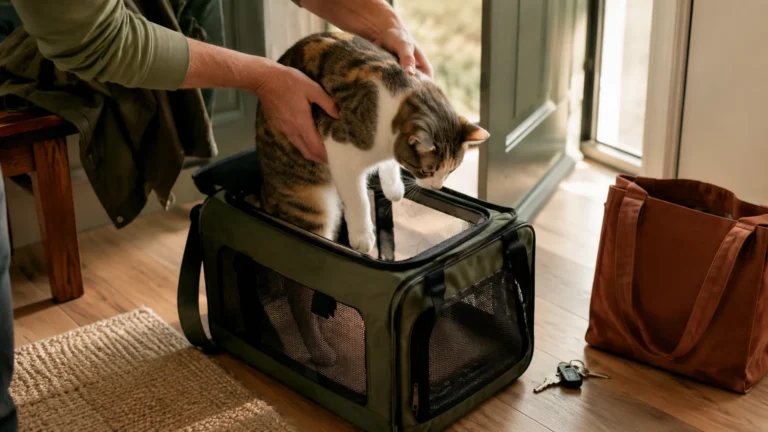
The best cat carrier for travel is a hard enough shell that your cat can stand, turn around and lie down in, with a front door and a top that opens or lifts off. The top is the part most buyers ignore and the part veterinary behaviour specialists rank first, because it is what lets a frightened cat be examined without being dragged out through a tunnel.
The second half of the answer has nothing to do with the bag. A carrier that only appears on the day of a trip is a carrier your cat has learned to fear. The American Animal Hospital Association quotes feline specialist Ilona Rodan, DVM, DABVP, on where to spend your effort: “The number one thing is carrier training.” The right carrier bought and left in a cupboard will not outperform an ordinary carrier that lives in your living room.
Match the carrier to the trip
| Travel situation | Best fit | Why |
|---|---|---|
| Vet visits | Top-opening or removable-top carrier | The exam can happen in the base of the carrier instead of starting with a struggle. |
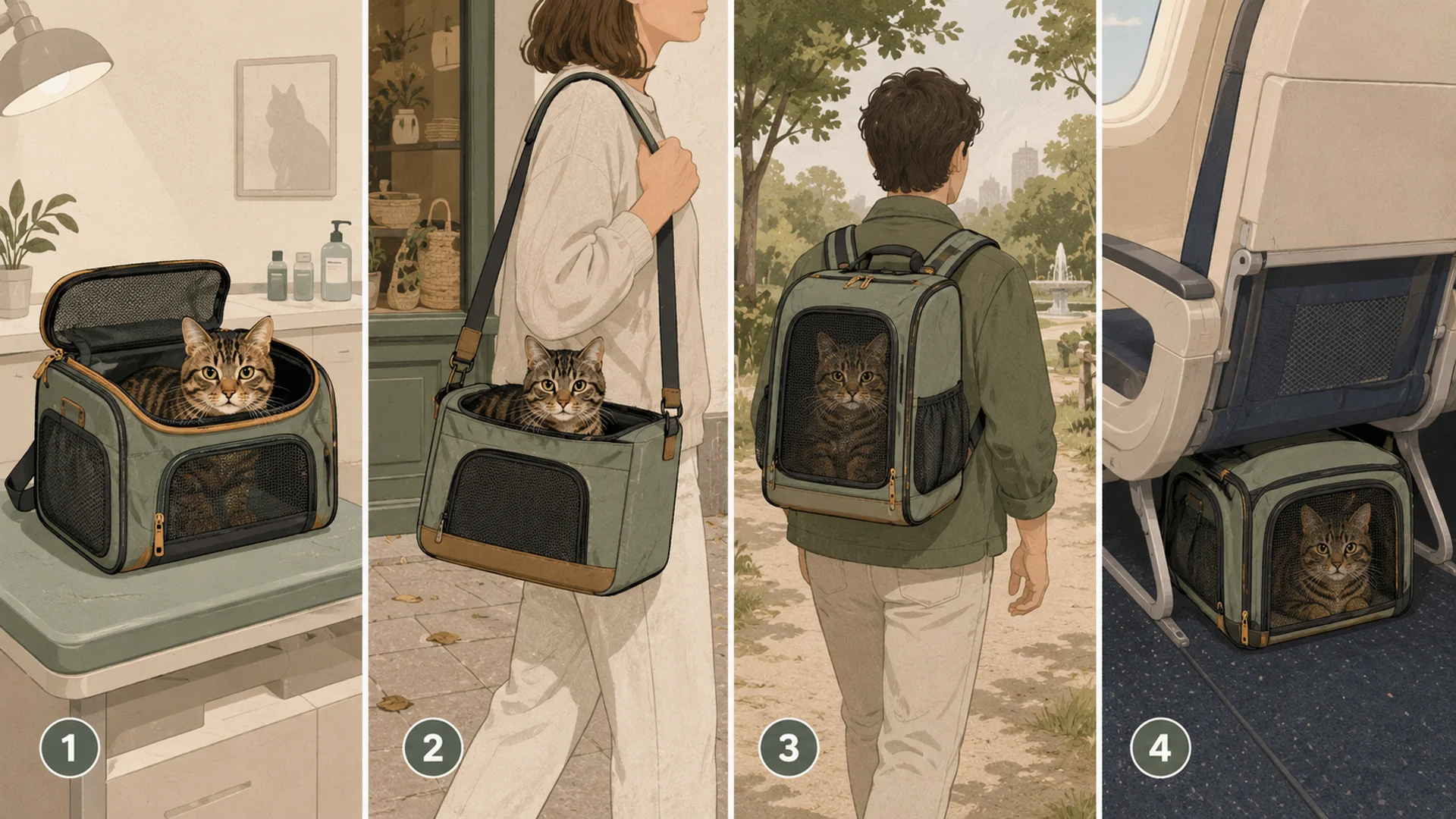
| City errands | Tote or compact backpack | Easier to keep close and off the ground in crowded spaces. |
| Car trips | Structured carrier that can be belted or floor-set | It has to stay put; a sliding carrier adds motion the cat cannot brace for. |
| Flight days | Soft-sided under-seat carrier | Flexible sides matter, and each airline sets its own dimensions — check theirs. |
The checklist vets actually use
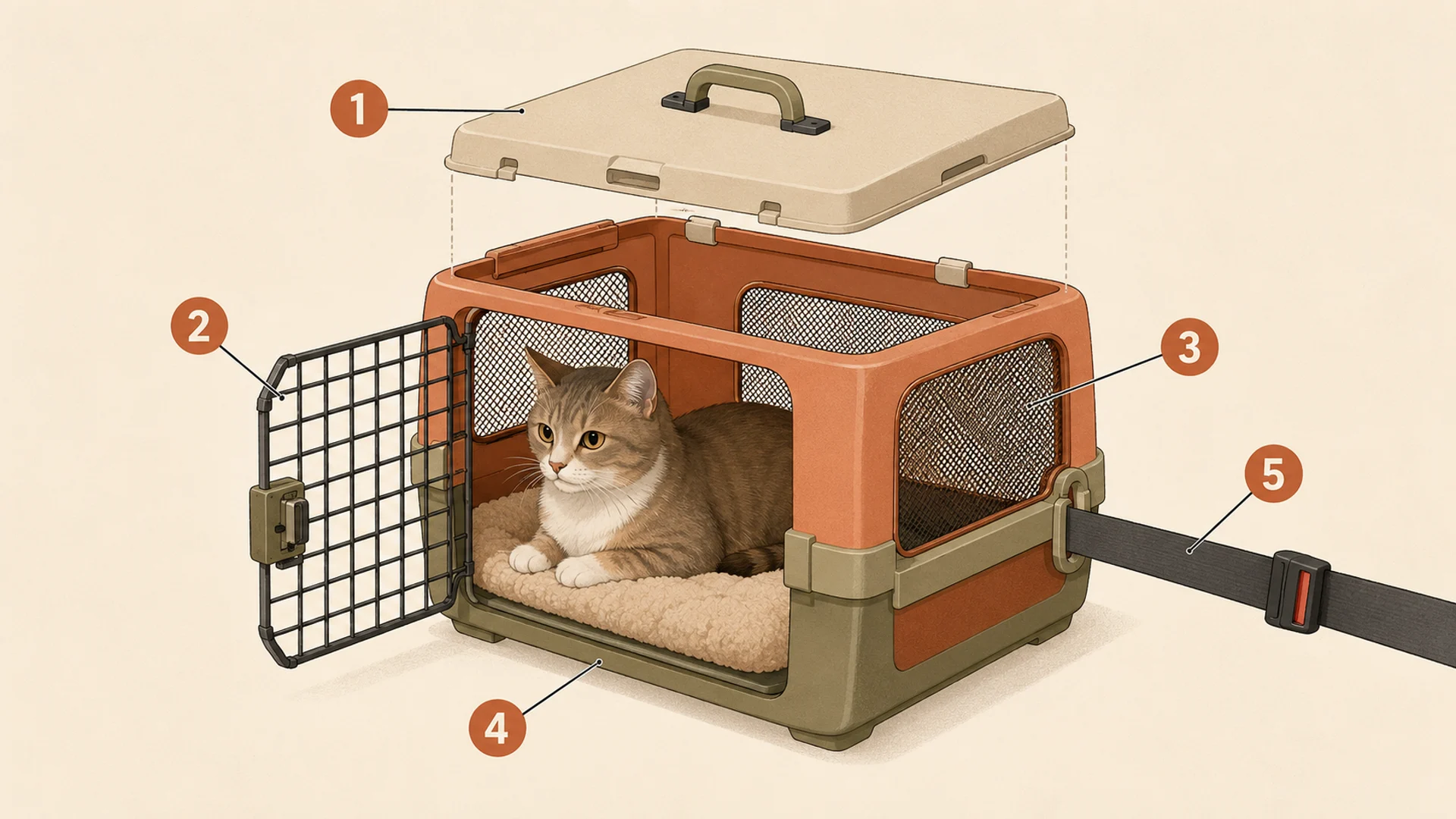
AAHA’s guidance, drawing on feline practitioners Ilona Rodan and Sarah Heath, BVSc, DipECAWBM, sets out what a good carrier has to do. It is a short list and it is worth reading before the marketing copy on any product page:
- Room to stand, turn around, sit and lie down comfortably. Not “room to fit” — room to change position.
- Well ventilated. Mesh or vents on more than one side, so airflow does not depend on which way the carrier is facing.
- Easy to clean. Assume at some point it will need to be.
- A front door for voluntary entry. The goal is a cat who walks in, not a cat who is posted in.
- A removable top or top-opening design. AAHA lists this specifically for “easy veterinary access” — and repeats it in its clinic advice: use top-opening or removable-top carriers to reduce handling stress.
- One carrier per cat. In a multi-cat household, each cat should have their own.
The top-opening point deserves its own sentence, because it is the difference between two very different vet visits. With a removable top, the lid comes off and a cat who does not want to move can be examined sitting where they already are. With a front-door-only box, someone has to reach in and pull. If you buy on one feature, buy on that one. Our top-loading cat carrier guide goes deeper into the mechanics of the different lid designs.
Soft, hard, or backpack
Soft carriers are lighter, store flat and are less intimidating to leave open at home — which matters more than it sounds, because leaving it open at home is the whole training method. Their weakness is the base: if the floor flexes when you lift, your cat spends the trip bracing.
Hard carriers give you structure and are the easiest shape to find with a genuinely removable top. They are bulkier to carry through a city and heavier to hold against your body, which is the recommended way to carry one.
Backpacks free your hands and suit longer walks, but they demand real ventilation and a base that does not sag. They are the wrong first carrier for a cat who has never been trained to a carrier at all — start with something you can leave open on the living room floor, and add the backpack when your routine needs it.
Carrier training is the part that works
The AAHA guidance is blunt about the mechanism: when carriers “only appear just before a veterinary visit, cats learn to associate them with scary things like confinement and loss of control.” The fix is to remove the signal by making the carrier permanent furniture.
- Keep the carrier out, in a spot your cat already likes, at a height your cat prefers.
- Put soft bedding in it. Warmth helps acceptance.
- Do not start by putting treats inside. AAHA’s recommended order is to toss high-value treats near the carrier first, then just inside the entrance, then gradually further in — letting the cat set the pace.
- If your cat is already anxious, avoid feeding regular meals in the carrier — Rodan warns this can build negative associations with their food instead.
- Cover part of the carrier if it helps your cat feel secure. Some cats prefer no covering at all.
- Never force your cat in. AAHA is explicit that forcing a cat into a carrier even once can undo weeks or months of careful training.
It is not too late for an adult cat. Rodan’s own example, quoted by AAHA, is that she trained her first cat at twelve years of age — progress is slower, but the direction is the same.
How you carry it, and where it rides
Handling is a stressor people do not think of as one. AAHA’s advice from Rodan: “Don’t carry it by the handle. Use two arms to snug it against you[r body]” — a carrier swinging from a handle bumps into legs and doorframes, and the cat inside cannot see it coming. Hold it elevated, against your body, and walk without jolting it.
In the car, the carrier has to be fixed in place. The American Association of Feline Practitioners’ position statement on transportation of cats in motor vehicles frames it as one of three things caregivers should be taught, alongside choosing “an appropriate carrier (size and material) for the cat” and “acclimating and training the cat to the carrier”: the “secure placement of the carrier within the vehicle.” AAHA’s practical version is to put the carrier on the floor or secure it well, and drive smoothly.
The Merck Veterinary Manual adds the two rules that cover the rest of car travel: “Keep small animals in their carriers while in the car, for both their safety and yours,” and “Cars can heat up quickly, so never leave a pet unattended in a vehicle.” Merck also recommends building tolerance the same way you build carrier tolerance — “Take your pet on short car rides in its carrier to help it get used to the experience” — rather than making the first car trip a long one. If road trips are your main use case, our guide to cat carriers for car trips covers the setup in more detail.
One health note: drooling, vomiting or persistent distress in the car is worth raising with your vet rather than working around. Motion sickness and travel anxiety in cats both have management options, and which one you are looking at is a question for the clinic, not the carrier.
TuckTrail pick
The Everyday Soft Top-Open Pet Carrier opens from the top as well as the front, which is the feature worth prioritising if vet visits are the trips you dread. Leave it open at home for a few weeks before you need it — that part matters more than the bag.
At the clinic
The carrier keeps working after you arrive. AAHA’s clinic advice is to leave your cat in the carrier until the veterinarian is ready, not to tip or drag them out, and to let them exit voluntarily wherever possible. Heath’s point is that the pressure to hurry usually comes from the owner, not the vet: give the cat the time to come out on their own while you are giving the history. A removable top is what makes that possible — the exam can start without the cat ever leaving what they consider their safe box.
Cat travel carrier FAQ
What is the most important feature in a cat carrier?
A top that opens or comes off. AAHA lists a removable top or top-opening design as a carrier requirement for easy veterinary access, and recommends it again as a way to reduce handling stress at the clinic. Everything else — ventilation, a flat base, easy cleaning — matters, but the lid is the one that changes how a vet visit goes.
Do cats prefer hard or soft carriers?
It depends on the cat more than the category. Soft carriers are lighter and easier to leave open at home; hard carriers give more structure and are easier to find with a genuinely removable top. Either works if the cat has been trained to it. Neither works if it only comes out on vet days.
What is the easiest carrier for a cat who hates carriers?
Any carrier they can walk into voluntarily, with a top that opens so you never have to reach in and pull. Then retrain: leave it out permanently with soft bedding, toss treats near it before inside it, and let the cat set the pace. Forcing a fearful cat in even once can undo weeks of progress.
How big should a cat carrier be?
Big enough for your cat to stand, turn around, sit and lie down comfortably — room to change position, not just room to fit. Oversizing has its own cost in the car, where a cat with too much space slides around instead of bracing, so aim for comfortable rather than roomy. How to measure your cat and check a carrier at home is in what size carrier for a cat.
Where should a cat carrier go in a car?
Secured, not loose. AAHA’s practical guidance is to put the carrier on the floor or secure it well, then drive smoothly; the AAFP treats secure placement in the vehicle as a core thing cat owners should be taught. Merck’s rule is simpler still: keep small animals in their carriers while the car is moving, and never leave a pet unattended in a parked vehicle.
Can I use the same cat carrier for flights and vet visits?
Often, but not always. Flight days add dimension limits that each airline sets for itself, and the low, flexible shape that fits under a seat is not always the shape that gives you the best top access at the clinic. Check the airline’s own current requirements before you assume one carrier covers both.
Is it too late to carrier-train an older cat?
No. Progress takes longer with an adult or senior cat, but the method is the same and it still works — the AAHA piece cites a feline specialist who trained her own cat at twelve. Patience, consistency, and never forcing it are what make the difference.
Buy the lid. Then leave it open on the floor.
Room to turn around, ventilation on more than one side, a flat base, a front door, and a top that lifts off — that is the whole specification, and the top is the part worth paying for. Then do the thing that costs nothing and works better than any feature: make the carrier a piece of furniture your cat already likes, months before you need it.
Sources
- American Animal Hospital Association — Helping your cat cope with veterinary visits (checked 2026-09-03)
- American Association of Feline Practitioners — 2020 Transportation of Cats in Motor Vehicles position statement (checked 2026-09-03)
- Merck Veterinary Manual — Traveling by Car With Pets (checked 2026-09-03)
Airline carrier requirements are set by each carrier and change; confirm on the airline’s official page before you travel. If your cat shows distress, drooling or vomiting during travel, talk to your veterinarian.