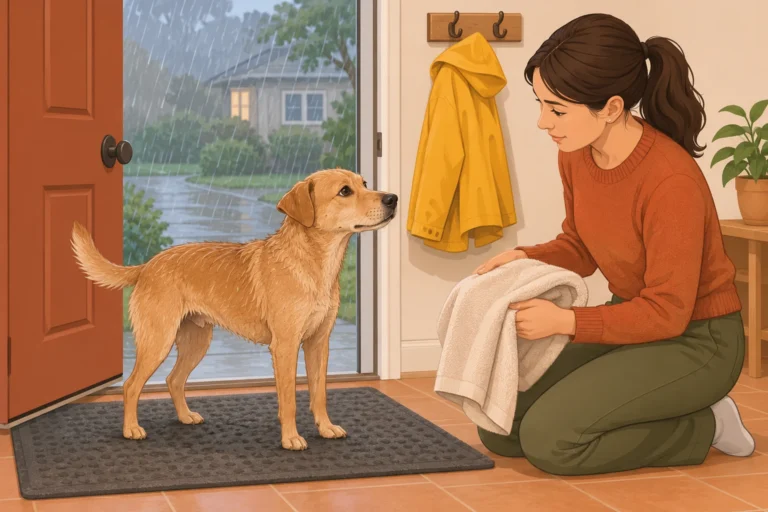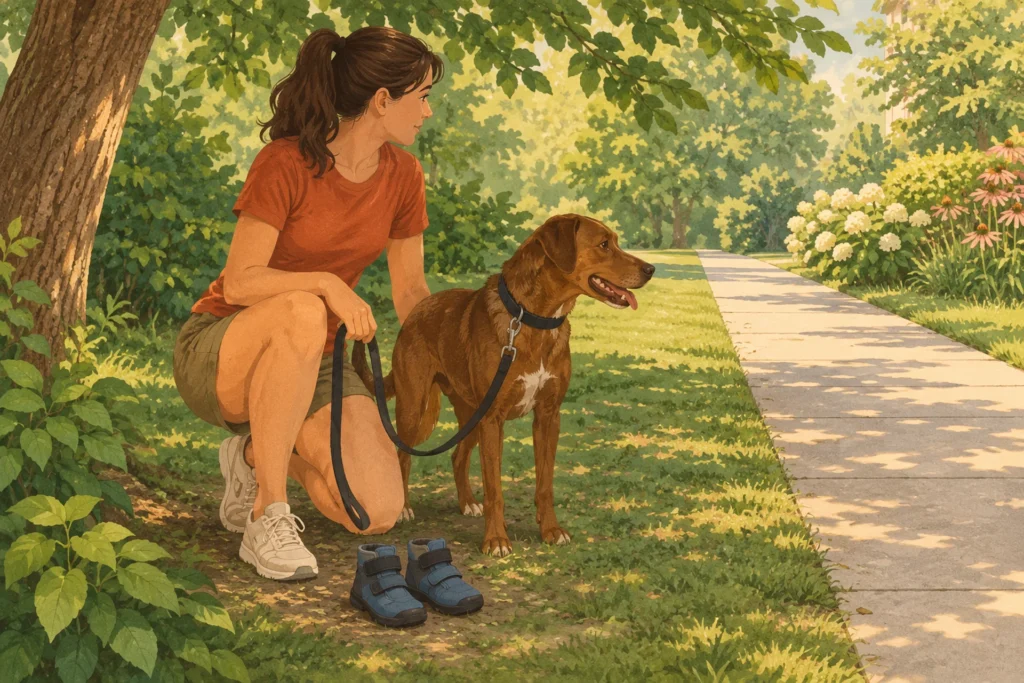
Dog boots can provide a barrier against hot pavement, but they do not make a hot-weather walk safe. The American Kennel Club says shoes can protect paws from hot surfaces. UC Davis veterinary guidance puts cooler walking times and shaded or grassy routes first, with protective booties when hot surfaces are unavoidable.
Start by changing the time or route. If you still need footwear, confirm its intended use and fit with the maker before relying on it. A product recommendation is not a tested heat rating. For your dog’s individual health needs, ask your veterinarian.
The awkward part is often the pavement between the door and the grass. That is a different decision from planning a long afternoon walk because the dog has shoes. Separate the necessary crossing from the exercise you can move to another time.
What problem are you trying to solve?
| Your situation | First choice | Where boots fit |
|---|---|---|
| You can choose another walking time | Recheck conditions during a cooler part of the day | Do not use footwear as a reason to keep the hotter appointment |
| A shaded, grassy route is available | Use it rather than the exposed paved loop | Consider equipment only for the surfaces you cannot avoid |
| Pavement separates the exit from a suitable toilet area | Plan the route and destination before opening the door | Appropriate, familiar footwear may be part of that plan |
| Your dog is limping or showing distress | Stop the outing and seek veterinary advice | A different shoe is not the next step |
Paw protection and whole-body heat are separate checks
A sole separates a paw from a surface. It is not air conditioning for the dog above it. Cornell’s veterinary school explains that hot or humid conditions and strenuous exercise can cause heatstroke. Covering the feet does not remove those conditions.
That is why “the shoes stayed on” cannot be the only successful outcome. Decide whether the outing itself is sensible, then decide whether its unavoidable surfaces need protection. If the plan requires the boots to solve both problems, change the plan.
The weather app does not describe every surface
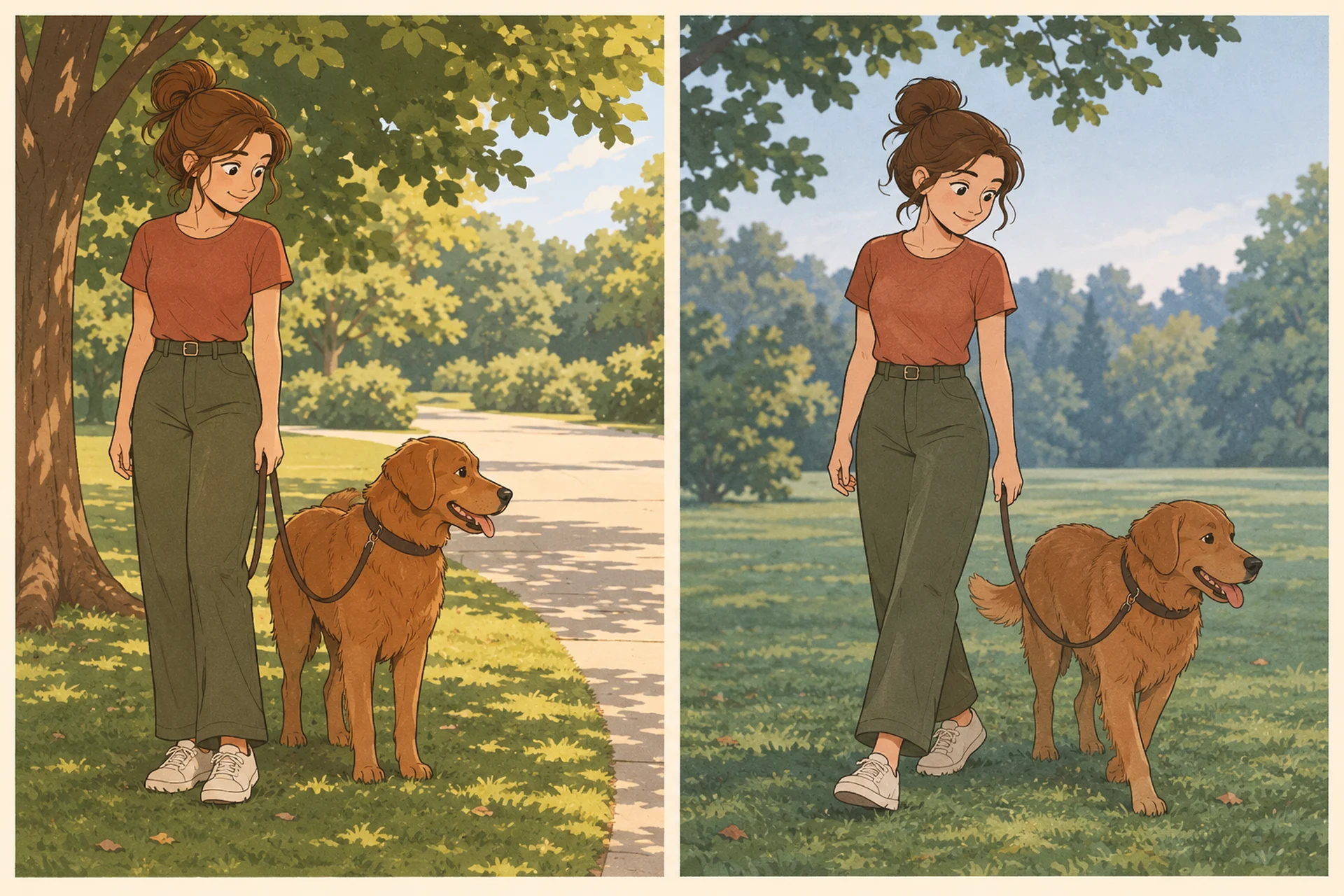
Cornell notes that blacktop can be much hotter than the surrounding air. UC Davis also identifies sand and artificial turf among surfaces that can become dangerously hot. Do not assume a change from asphalt to another exposed material solves the problem.
Check the actual route rather than using yesterday’s conditions or the forecast alone. A hand check that feels uncomfortable is a reason to avoid that surface, not an invitation to use the dog as the final test. Neither the sources nor this guide establish a universal number of safe minutes for any boot on any pavement.
Keep the decision simple: where will the dog walk, where can you stop away from the exposed surface, and how will you return? If the only destination is another sunny stretch of pavement, there is no useful refuge in that plan. Choose a different outing.
Read the boot description for its job, not its appearance
The AKC recommends a snug fit that is neither tight nor loose, with suitable closures and grip. A boot that looks substantial in a photograph still needs clear instructions. Ask what surfaces the maker intends it for, how it should be fitted, and what limitations apply.
Do not translate “outdoor,” “all-season” or a picture of a thick sole into a temperature certification. If a listing gives a heat claim without explaining the test or intended use, ask for clarification instead of supplying the missing detail yourself. The same caution applies to ordinary socks: the name alone does not establish protection from a hot surface.
Fit and staying on are their own questions. Our guide to boots that keep falling off covers measurements and movement checks. Sorting out retention indoors is more useful than discovering a twisting boot halfway across an exposed path.
Make the first trial somewhere cool
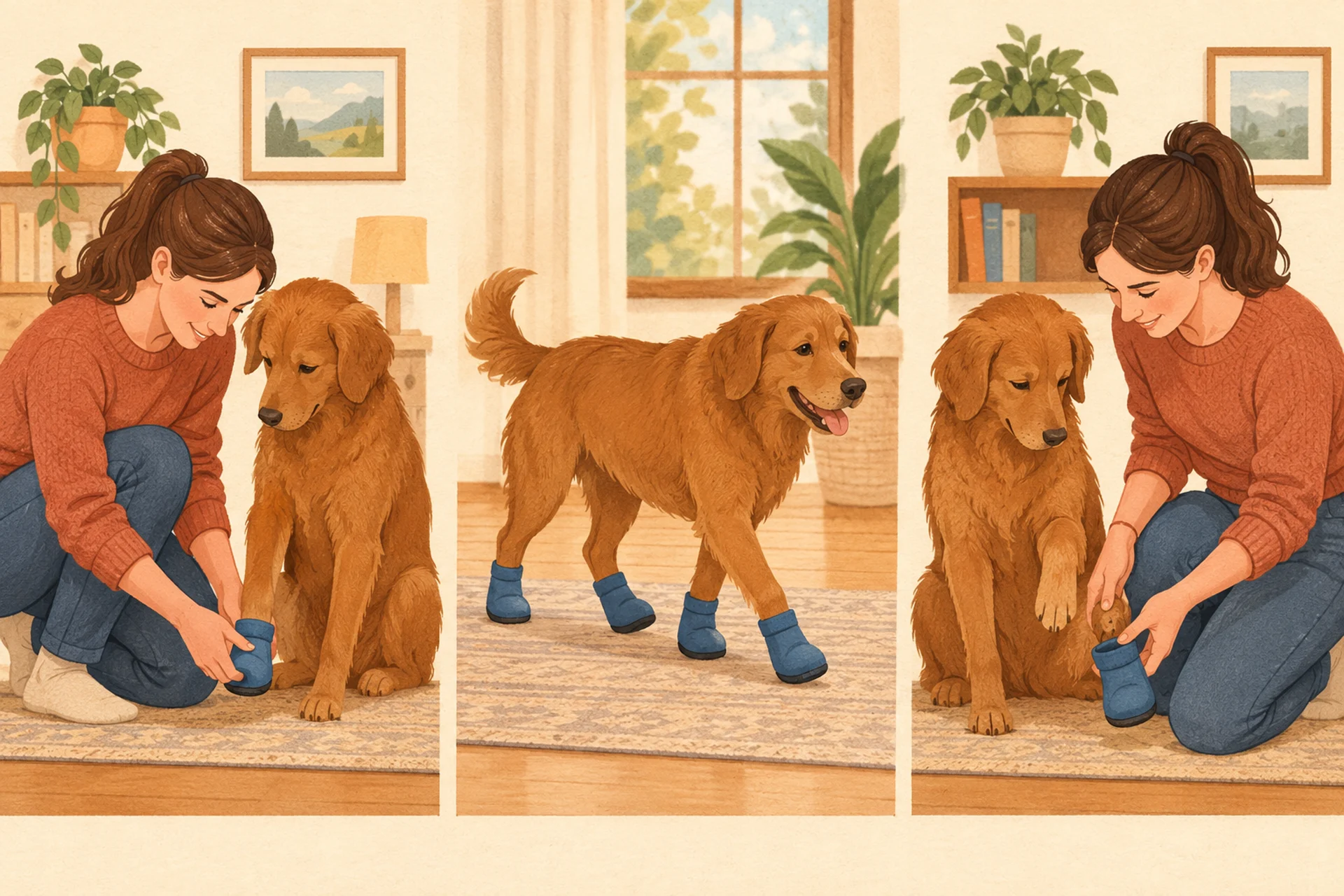
Do not make the first attempt to wear shoes at the hottest part of the route. The AKC notes that many dogs need time to adjust before an outing. Follow the maker’s instructions in a cool, familiar setting where stopping is easy.
Watch the dog stand, walk and turn. Can you identify which boot is which and put it on consistently? Does the dog move comfortably? Can you remove the equipment without a struggle? These practical questions help you decide whether it is ready for an outing; they do not measure thermal protection.
- Before leaving: identify the cooler route and an easy return.
- Before relying on a boot: confirm intended use and fit instructions.
- During the outing: watch the whole dog as well as the feet.
- If the plan stops working: end or change the outing instead of trying to earn a certain distance.
When to stop and call your veterinarian
New limping or repeated paw licking after a hot walk warrants attention. VCA identifies these as possible signs of pad injury and recommends veterinary assessment. Do not assume the cause is merely an unfamiliar shoe or keep walking to see whether it improves.
For the dog as a whole, Cornell flags heavy panting and seeking shade as early overheating signs. Difficulty breathing, confusion, weakness or collapse need immediate veterinary attention. Stop the activity, get out of the heat and contact a veterinarian or emergency hospital. Do not wait for a boot adjustment to fix those signs.
Tell the clinic when the outing happened, which surfaces were involved, whether boots were worn and what changed. These observations help the conversation; they are not a diagnosis. Treatment and decisions for an individual dog belong with the veterinarian.
Hot-pavement boots: FAQ
Do boots protect dog paws from hot pavement?
Appropriate boots can provide a barrier, as the AKC and UC Davis describe. They do not remove the need to avoid hot surfaces or decide whether the weather is suitable for a walk.
Can my dog walk longer in the heat if they wear shoes?
Do not use shoes to extend a hot outing. Paw protection does not remove heat and humidity around the dog. Move exercise to cooler conditions.
Are winter boots automatically suitable for summer pavement?
The label alone cannot answer that. Check the specific maker’s intended use, fitting instructions and limitations rather than inferring protection from a photograph or a seasonal name.
How many minutes are boots safe on hot pavement?
This guide cannot give a universal duration. The sources do not establish one for every boot and surface. Reduce avoidable exposure and change the route instead of treating a timer as permission.
What if my dog refuses to wear boots?
Do not make the hot path a training session. Choose a cooler time or another route, and work on footwear separately in a comfortable setting.
Should I put a boot over a sore paw?
Ask your veterinarian first. A sore or newly limping paw needs assessment; buying or tightening footwear does not identify the cause.
Sources
- American Kennel Club — How to Protect Dog Paws From Hot Pavement (checked 2026-11-14). Footwear, fit, acclimation and cooler routes.
- UC Davis School of Veterinary Medicine — Summer Pet Hazards (checked 2026-11-14). Surface hazards and protective booties when avoidance is not possible.
- Cornell University College of Veterinary Medicine — Summer Heat Safety Tips for Dogs (checked 2026-11-14). Environmental heat, pavement, warning signs and veterinary urgency.
- VCA Animal Hospitals — Torn or Injured Foot Pads (checked 2026-11-14). Paw licking, limping and veterinary assessment; no home treatment instructions reproduced.
Guidance and product instructions can change. Confirm the current official information and ask your veterinarian about decisions for your dog.