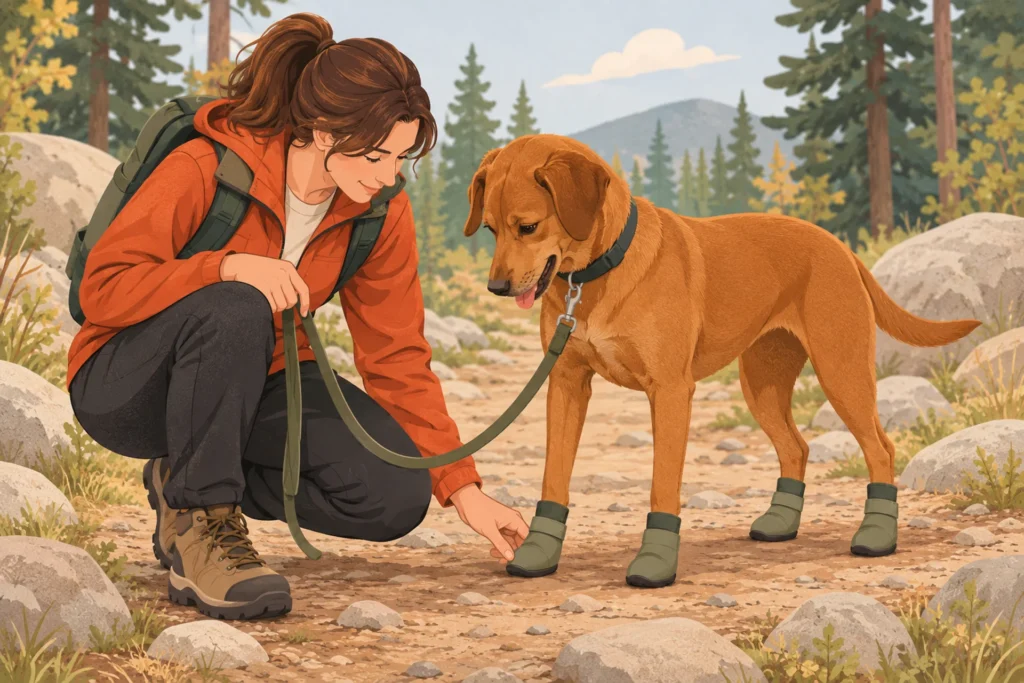
Dog boots for hiking make sense when the ground is the problem. VCA Animal Hospitals recommends packing booties for rough terrain; that is a reason to prepare, not a rule that every dog needs shoes on every trail. Choose footwear for the surface, teach your dog to walk comfortably in it, and keep a route home that does not depend on the boots working perfectly.
The useful question is not which pair looks toughest. It is what you expect a bare paw to encounter, and whether your dog moves better with that particular boot on.
If you are searching for hiking dog booties or dog shoes, use the same checks below. Those names do not establish what a sole, closure or upper can handle. Start with the difficult section of your route, then decide whether footwear or different ground is the better choice.
Start with the ground, not a product ranking
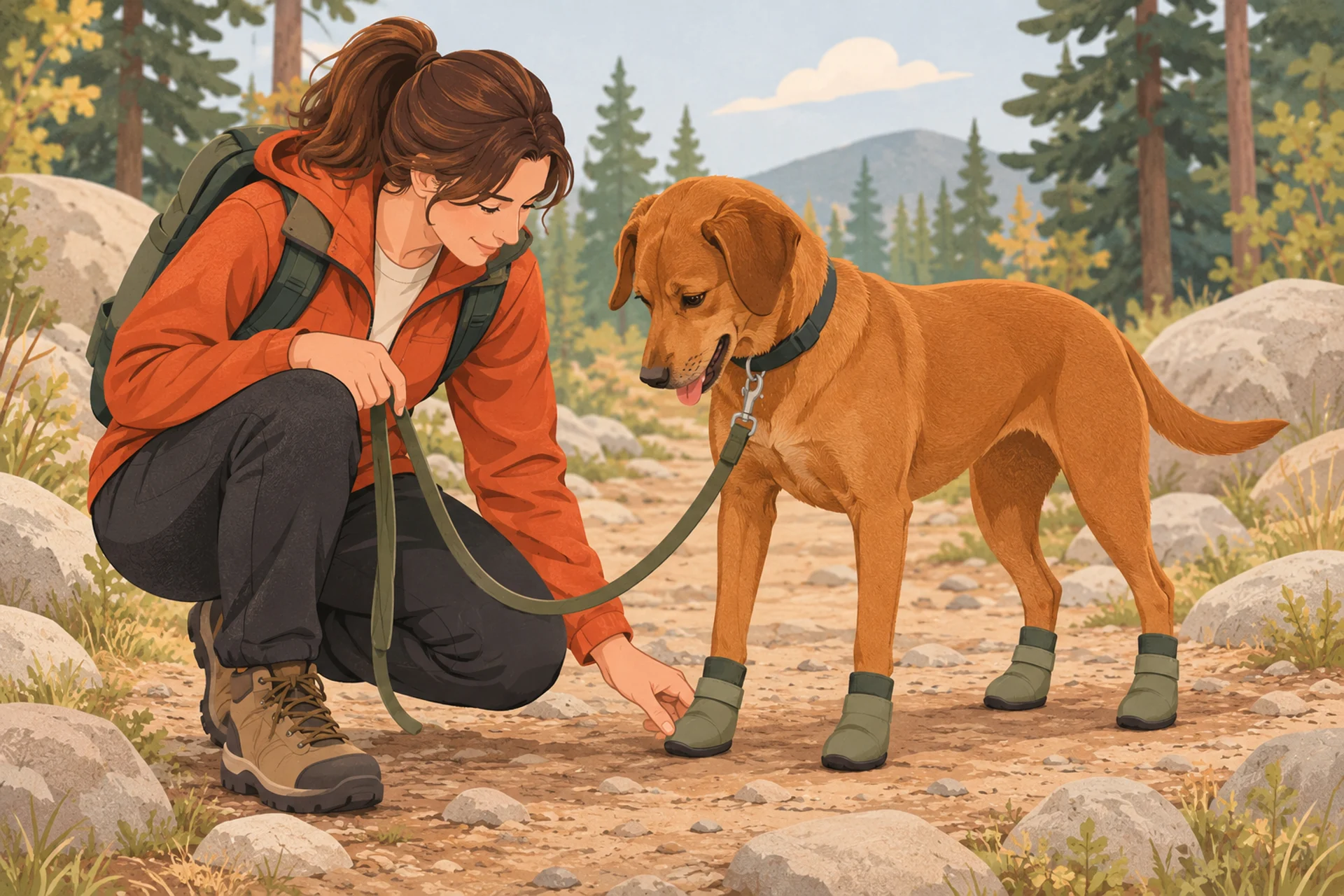
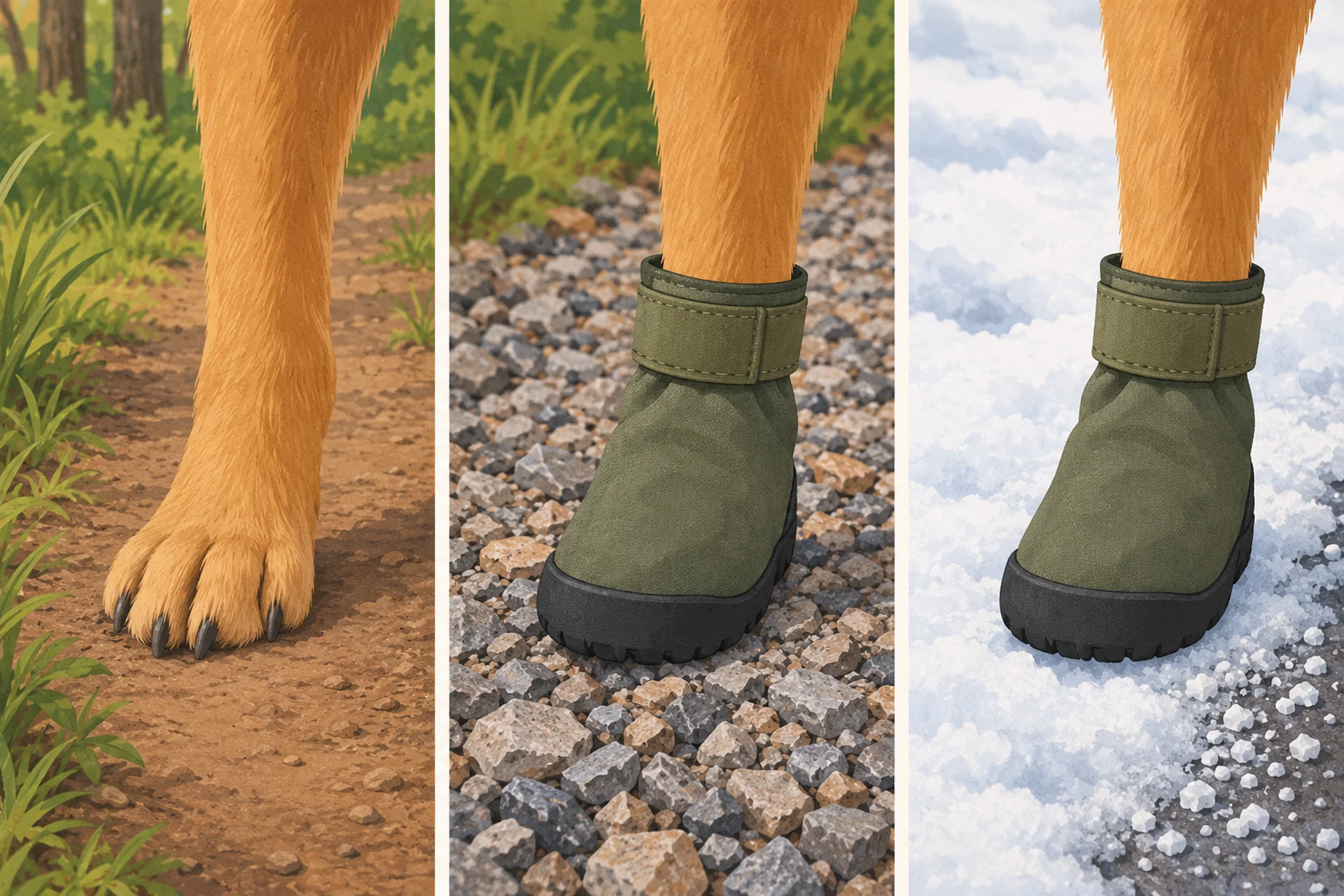
A smooth woodland path and a stretch of coarse gravel can be parts of the same walk. Plan for the harder section rather than buying for the photograph at the trailhead. The American Kennel Club’s boot guide distinguishes hiking footwear from rain boots, noting that hiking calls for traction on rocks and uneven terrain. A boot sold for wet sidewalks is not automatically the right tool for a rocky climb.
| What is underfoot? | What to consider | A sensible alternative |
|---|---|---|
| Smooth, cool, familiar ground | Do not add boots merely to complete an outfit. | Keep the outing within the dog’s comfortable experience. |
| Rough, abrasive or sharp terrain | Pack fitted boots and practise using them before the outing. | Choose a smoother path if the dog cannot walk comfortably in boots. |
| Hot pavement or sand | A covering is one layer of protection, not permission to ignore the heat. | Go at a cooler time or choose shade. |
| Snow, ice or treated paths | Consider paw protection and check for packed snow or salt. | Shorten or change the route. |
| A paw that already hurts | A boot does not explain or fix the pain. | Stop and ask your veterinarian. |
Match the boot to the job
Make a short list of requirements before comparing models: the surface, the likely weather, the closure and the fit information you can actually obtain. The AKC recommends a hiking sole with traction and describes different footwear for different conditions. Treat terms such as “all terrain” as a prompt to inspect the design, not as proof that a boot will work everywhere.
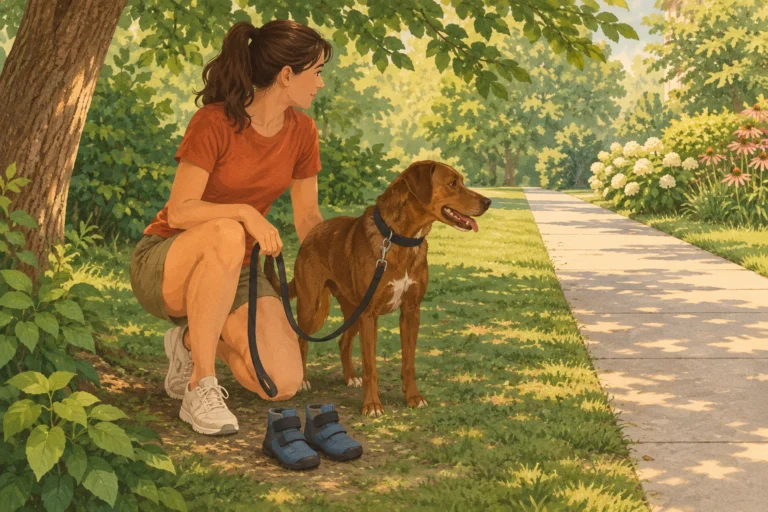
For hot approaches, the AKC’s hot-pavement guidance describes shoes as protection while also recommending cooler times of day and grassy or shaded areas. It says the fit should be snug without being too tight or loose. That leaves an important choice with you: change the walk when conditions are poor rather than asking equipment to rescue the plan.
For winter ground, Cornell’s veterinary guidance recommends checking paws for cuts, cracks and snow between the toes, and training dogs to wear well-fitting booties. Our winter boots guide separates cold exposure from salt and packed snow. A dry summer trail and a salted winter path are different jobs.
Fit is something to test, not just a size to order
The AKC describes tracing a paw under pressure to allow for its spread, then measuring the widest part. Follow the exact model’s instructions about stance and measurements; do not substitute a body-weight label for a paw measurement. Keep the measurement and the manufacturer’s chart together while comparing options.
Use the sizing instructions for the exact model. Before leaving home, put the boots on and watch a short, ordinary walk. Can the dog move comfortably? Do the boots remain in position? Is the dog repeatedly trying to remove them? A size label cannot answer those questions.
Choose a test close to home, where changing your mind costs little. A loop you can abandon is more useful than discovering a problem halfway through an out-and-back. If you cannot get a comfortable fit, postpone the rocky route. Buying another size or choosing different ground is a practical decision; repeatedly tightening a troublesome boot is not a plan.
Compare a pair before committing to the trail
| Question to answer | Evidence you can check | If you cannot answer it |
|---|---|---|
| Does it suit this surface? | The maker’s intended use and the sole’s design, followed by a short trial on manageable ground. | Choose a simpler route instead of treating “hiking” as a performance guarantee. |
| Can I obtain a comfortable fit? | The model’s paw-size chart and an indoor walking test. | Reconsider the size or design before leaving home. |
| What happens if a boot is lost or damaged? | A route you can shorten and a practical way home. | Change the outing; carrying a spare does not solve an already uncomfortable fit. |
| What claim is actually supported? | Specific information from the maker, rather than only a product name or photograph. | Do not assume puncture resistance, all-weather traction or a guaranteed walking distance. |
This is a comparison checklist, not a test certificate for any boot. Bring unresolved questions to the seller before you rely on the product. A listing that says “outdoor” is not an answer to a question about sharp debris or the surface you plan to cross.
Practise before the day you need protection
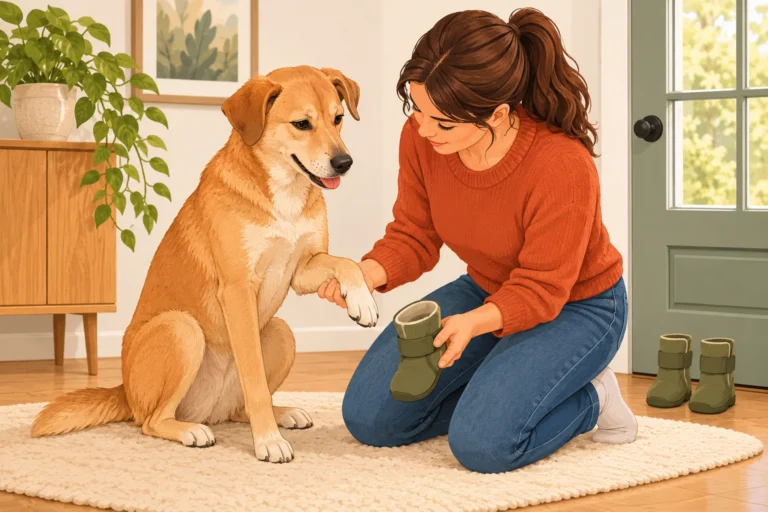
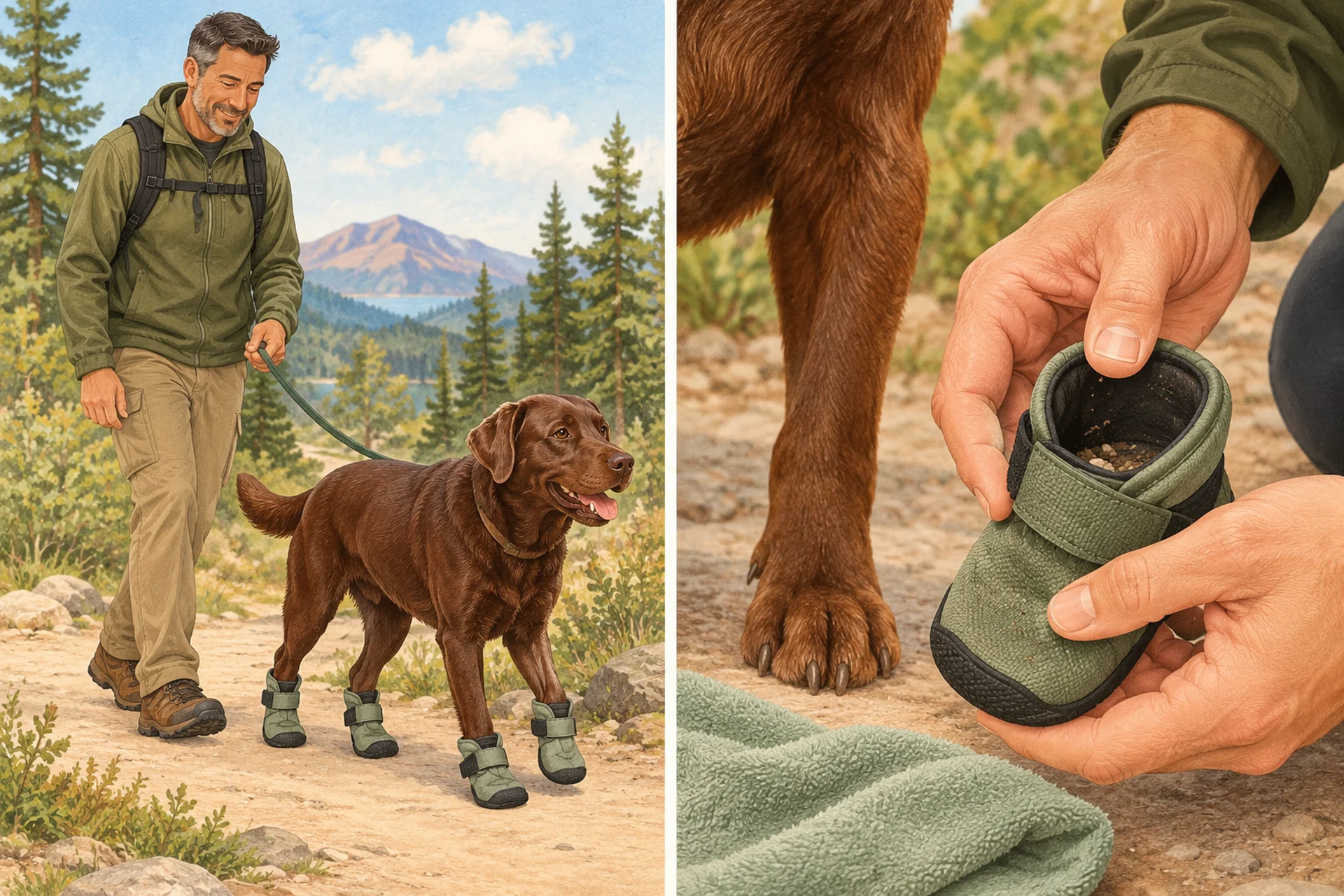
The AKC’s introduction routine starts with letting the dog investigate the boots, rewarding brief wear of one boot, then gradually adding boots and time. Outdoor practice begins with a short walk after the dog is comfortable at home.
Do not combine the first fitting with the longest walk. Give yourself room to find out whether the problem is unfamiliar equipment or equipment that does not suit the dog. If the dog keeps trying to remove a boot, reduce the training demand instead of insisting on finishing the session. The goal is comfortable movement, not a dog that has stopped objecting.
Decide what will make you stop
Set the limit before you are committed to the route: repeated boot loss, an uncomfortable gait or a sore foot means changing the plan. Stop to check rather than counting how much distance remains. A boot coming off once is an inconvenience; continuing despite a dog struggling to walk is a different decision.
VCA’s veterinary foot-pad guidance notes that licking and limping can accompany torn, punctured or burned pads and recommends veterinary attention for injuries. Do not cover a painful paw and assume the hike can continue. Ask your veterinarian about a dog with an existing paw problem before planning a walk that relies on protective footwear. This is equipment guidance, not a diagnosis or a wound-treatment tutorial.
A short checklist before leaving
- Name the surface that makes boots useful on this particular walk.
- Use the exact model’s sizing instructions and test comfortable movement.
- Complete short practice walks before committing to difficult ground.
- Choose an easy way to shorten the outing if the boots do not work.
- Check feet and equipment when the dog shows discomfort.
- Ask your vet about pain, an injury or a health condition that affects exercise.
Hiking dog boots: questions worth asking
Does every dog need boots for hiking?
No universal rule follows from the guidance above. VCA specifically recommends packing them for rough terrain. Make the decision about your dog’s feet and the surface, rather than the fact that the outing is called a hike.
Are rain boots the same as hiking boots?
Not necessarily. The AKC distinguishes their intended jobs. Check traction, fit and the manufacturer’s intended use instead of assuming a rain boot is suitable for rocks.
Can boots make hot trails safe?
Do not use them as that promise. The AKC recommends cooler walking times and shade as well as paw protection. Changing the route or postponing the outing remains an option.
What if the boots keep coming off?
Stop and reassess the fit and training. Do that close to home first. Our guide to boots that keep falling off works through those causes.
Can I put a boot over an injured paw?
Ask your veterinarian what protection and activity are appropriate. A covering does not make a painful or injured foot ready for a hike.
Will hiking dog boots stop thorns or cactus spines?
Do not assume a boot is puncture-proof because it is sold for hiking. Verify the maker’s claims and choose a route that does not depend on an unverified promise. If your dog becomes lame or a paw appears injured, stop and contact your veterinarian; this guide does not teach removal of embedded objects.
Sources
- VCA Animal Hospitals — Hiking with your dog 101 (checked 2026-11-07)
- American Kennel Club — Choosing dog boots for different conditions (checked 2026-11-07)
- American Kennel Club — How hot is too hot for a dog’s paws? (checked 2026-11-07)
- Cornell University College of Veterinary Medicine — Winter safety tips (checked 2026-11-07)
- American Kennel Club — Introducing boots gradually (checked 2026-11-07)
- VCA Animal Hospitals — Injured foot pads (checked 2026-11-07)
Written and updated by Codex (OpenAI) for TuckTrail. General information, not veterinary advice. Ask your veterinarian about your dog’s health, injuries and exercise limits.